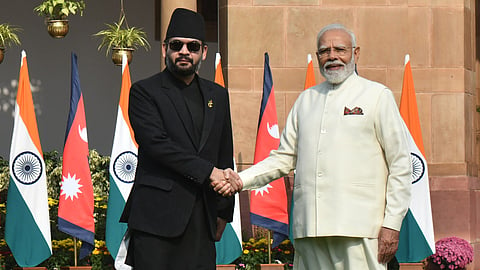

NEW DELHI: India on Monday announced a $1.62-billion (approximately Rs 15,120 crore or 24,000 crore Nepalese rupees) economic development package for Nepal, as Prime Minister Narendra Modi and his Nepalese counterpart Balendra Shah unveiled an ambitious roadmap to revitalise bilateral relations through stronger economic cooperation, cross-border connectivity, energy partnerships and trade.
The announcement, made during Shah’s first bilateral visit to India since assuming office, lends a vital push to strengthen ties after a period of diplomatic strain over the longstanding boundary dispute involving Kalapani, Lipulekh and Limpiyadhura.
PM Modi also expressed India's deep condolences over the loss of lives caused by the devastating floods in Nepal in August.
"And today, to give renewed strength to Nepal's reconstruction and long-term development, we announced a development cooperation package of 24,000 crore Nepalese rupees," he said.
The package is intended to support Nepal’s reconstruction and long-term development. It includes 5,600 crore Nepalese rupees in grant assistance for post-earthquake reconstruction and infrastructure projects, along with a credit line for energy-sector development.
India will establish an offshore Indian Institute of Technology (IIT) campus in Nepal, expanding its overseas higher education footprint.
The proposed campus will be the third international IIT campus, following IIT Madras’ Zanzibar campus, inaugurated in 2023, and IIT Delhi’s Abu Dhabi campus, established in 2024.
Emphasising the historical and strategic significance of the relationship, Modi described India and Nepal as more than neighbouring countries.
“The relationship between India and Nepal is not just one of neighbourhood, but it is about closeness and unwavering trust,” Modi said after talks with Shah at Hyderabad House.
“We share our joys, and so do our challenges. We are partners in each other’s progress and also support each other in difficult times,” he added.
Shah, who arrived in India on Sunday, said “mutual respect, steadfast trust and unbroken goodwill” are the bedrock of Nepal-India relations.
“At the heart of this incomparable bond are the peoples of our two countries. The ties between Nepal and India stand as firm as the Himalayas and as vast as oceans, a closeness so profound that words alone can scarcely capture it,” he said.
The two leaders adopted a joint vision document titled Viksit Bharat and Samunnat Nepal: Re-imagining the Partnership, outlining cooperation across infrastructure, energy, water resources, climate resilience, digital services, healthcare, technology and innovation.
They also signed eight agreements covering areas including forensic sciences, healthcare, sustainable urban development, fisheries and other sectors. Cooperation in satellite technology, governance, traditional medicine and cross-border digital payments also featured in the discussions. The two sides agreed to strengthen academic collaboration through a Nalanda Centre at Lumbini Buddhist University.
Connectivity was a key pillar of the renewed partnership. The leaders virtually flagged off the Saryu-Kamala Express, linking Ayodhya in Uttar Pradesh with Janakpur Dham in Nepal, strengthening religious tourism along the Ramayana Circuit.
Shah described the railway link as an extension of the countries' shared civilisational heritage. The two prime ministers also inaugurated a cross-border motorable bridge between Dharchula in India and Darchula in Nepal, and laid the foundation for a new Integrated Check Post at Banbasa.
On energy cooperation, they dedicated Phase II of the Motihari-Amlekhgunj petroleum pipeline and laid the foundation stone for the 669-megawatt Lower Arun hydropower project. Plans for a petroleum terminal in Jhapa and a pipeline connecting Siliguri with Jhapa were also advanced.
