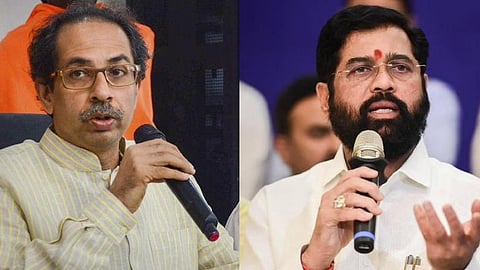

The Supreme Court on Tuesday resumed final hearing on pleas challenging the Maharashtra Speaker's refusal to disqualify MLAs of the Eknath Shinde-led camp of the Shiv Sena, with the faction defending the Election Commission's decision to recognise it as the "real" Shiv Sena.
The bench is also hearing a challenge by the Uddhav Thackeray-led faction to the Election Commission's February 17, 2023, order allotting the Shiv Sena name and its 'bow-and-arrow' election symbol to the Shinde camp.
Senior advocate Neeraj Kishan Kaul, appearing for the Shinde-led faction, said the Election Commission was within its jurisdiction under Article 324 of the Constitution to examine the democratic character of a political party's constitution and organisational structure while determining which faction represented the real party.
"Your Lordships must see the entire record. The question is whether the constitution was with the Election Commission," Kaul said.
The senior lawyer said the constitution relied upon by the Thackeray faction had not been registered with the poll panel, whereas the constitution submitted in 1999 followed detailed correspondence between the poll authority and the party. He said the Election Commission was not deciding which amendments should or should not be made to a party constitution, but was examining whether the organisational structure reflected the will of the cadres.
"If there are ad-hoc appointments and unelected appointees, the organisational structure does not necessarily reflect the will of the cadre," he said.
The senior advocate maintained that the poll panel had, for decades, corresponded with political parties about democratic functioning and their constitutions.
Such scrutiny fell within the poll panel's expansive powers under Article 324 of the Indian Constitution, he said.
"The EC is not striking down internal elections or deciding who was rightly or wrongly elected in the manner of a civil court," Kaul said, adding that the Commission could examine the party constitution, organisational structure and legislative wing while applying the appropriate test to determine the real party.
He also argued that the existence of a party constitution cannot prevent the poll panel from examining the organisational structure, particularly where large sections of the organisation were governed through ad hoc appointments.
Responding to the arguments concerning the legal distinction between a split in a political party and a split in its legislative wing, Kaul said the Shinde faction's case was based on a split in the political party.
"Our case has never been that there was merely a split in the legislative party. Our case is that there was a split in the political party," he said.
Kaul also referred to alleged discontent among the Shiv Sena cadre over the party's alliance with political parties they considered ideologically opposed to its principles. He said the organisational majority test was relevant because the Election Commission could not conduct a referendum among every primary member of a political party.
"The lifeblood of a political party is its cadre and grassroots workers who are directly connected to the electorate," he said.
If there was a disconnect between the party cadre and the ad hoc nominated bodies, the organisational majority test would lose its significance, Kaul said.
The hearing remained inconclusive and will continue on Wednesday.
On September 2, the Shinde faction told the top court that the organisational structure established by Shiv Sena founder Bal Thackeray to prevent concentration of power in the hands of the party chief and make it more "democratic" was significantly altered by Uddhav Thackeray in 2018.
Kaul had said that the party constitution was submitted to the Election Commission in 1999 after the poll body directed all the political parties to place their constitutions on record. After the demise of Bal Thackeray (in 2012), the party proceeded to fundamentally alter that structure, Kaul submitted.
The Uddhav Thackeray-led faction had earlier told the apex court that the use of the name Shiv Sena and its election symbol by the Eknath Shinde-led group was "illegitimate".
The top court was urged to at least prevent the Shinde group from using them if it did not immediately restore the symbol to the Thackeray faction.
The bench was hearing two pleas filed in 2024 by the Thackeray faction against the EC's order allotting the 'bow-and-arrow' symbol to the Shinde camp. The pleas also challenged the February 17, 2023, order of the poll authority, recognising the Shinde faction as the original Shiv Sena.
(With inputs from PTI)
