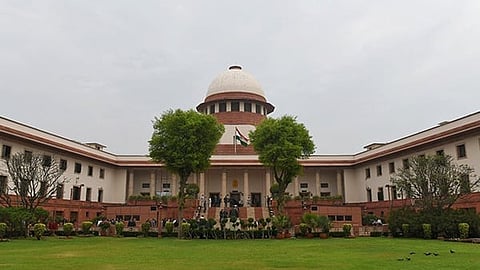

NEW DELHI: The Centre on Thursday told the Supreme Court that the state governments cannot invoke writ jurisdiction in moving the apex court against the actions of the President and the governor in dealing with the bills passed by assemblies for violation of fundamental rights.
"Neither Article 32 nor Article 226 is maintainable filed by the state or by a private individual in such a case since it is not Justiciable," the Solicitor General (SG) Tushar Mehta, senior law officer of the Centre, told the apex court's five-judge Constitution bench, headed by the Chief Justice of India (CJI) B R Gavai.
During the hearing, the top court observed that the term 'as soon as possible' used in Article 200 of the Constitution in deciding the fate of bills will serve no practical purpose if Governors are allowed to withhold consent for "eternity".
It also said the framers of the Constitution deliberately replaced an earlier six-week limit with the phrase 'as soon as possible' in Article 200 and asked the Centre whether this phrase can be ignored in deciding the fate of bills.
Mehta further made a case of Presidential reference, submitted that the President would also like to have an opinion on the scope of Article 361 of the Constitution, which says the President, or the Governor, will not be answerable to any court for the exercise and performance of the powers and duties of his office or for any act done.
Advancing the arguments in the case, senior lawyer appearing for Tamil Nadu state, Abhishek Manu Singhvi, submitted before the top court that accepting that the Governors can withhold assent even to money bills passed by a State legislature would effectively make them a "super Chief Minister" of a State.
The President acts on the advice of his Council of Ministers. In all other matters where the Governor acts in his discretion he will act in harmony with his Council of Ministers. The Constitution does not aim at providing a parallel administration within the State by allowing the Governor to go against the advice of the Council of Ministers, Singhvi argued.
"The Governor has no power to withhold, a Bill. The Governor has only three options and if he chooses not to assent to the Bill, he may, even without being bound by the aid and advice of the Council of Ministers, either return the Bill to the State Assembly once or refer it to the President when the Governor first receives the Bill. There is no so-called fourth option of making the Bill fail by withholding of assent simpliciter," Singhvi submitted.
Opposing the Presidential reference, Singhvi argued that the Governor does not have any independent discretion in the discharge of their Constitutional functions. This is in consonance with the principles of democracy and federalism, both of which are part of the basic structure of the Constitution.
"The role of the Governor is one of a riend, philosopher and guide. The Governor is only a facilitator, not interfere but a lubricator, and not cause confusion or chaos. It cannot be a case of two swords in the same scabbard," Singhvi contended.
Adding that he wanted to know as to whether the Constitution anywhere states that the last word on a bill would be of the Governor and not of an elected government. "How can the Governors’ be the last word in the enactment of a Bill? In responsible governments, there is no room for gubernatorial discretion. General discretion to Governor would create chaos," he said and pointed out that the argument of ‘general’ discretion of the Governor is baseless.
The arguments in the case on Thursday -- which was of 5th day of hearing -- were inconclusive and would continue in the apex court on August 02, Tuesday. The five-judge Constitution bench -- hearing the Presidential Reference case -- was headed by the CJI Gavai and four other senior most judges of the SC, comprised of Justices Surya Kant, Vikram Nath, P S Narasimha and A S Chandurkar.
Earlier on April 8, a two-judge bench of the Supreme Court comprising Justices J B Pardiwala and R Mahadevan, while hearing the case of State of Tamil Nadu against Governor of Tamil Nadu, held that the State Governor must act within three months if withholding assent or reserving a Bill, and within one month when a Bill is re-enacted. It also prescribed that the president should decide on the bills reserved for her consideration by the governor within three months from the date on which such a reference is received.
Challenging this verdict, President Murmu had moved the top court on May 13, with 14 crucial questions raised by her -- in the presidential reference -- challenging the SC's April 8 verdict that fixed timelines for governors and President to act on bills passed by state assemblies.
President Murmu, while exercising her power under the rarely used Article 143 (1), moved the apex court and said in the present circumstances, it appeared that 14 questions of law have arisen and they are of such nature and public importance that it is expedient to obtain the opinion of the Supreme Court.
Out of 14 crucial questions, the majority and important were as follows:
1) What are the constitutional options before a Governor when a Bill is presented under Article 200 of the Constitution of India?
2) Is the Governor bound by the aid & advice tendered by the Council of Ministers while exercising all options available with him when a Bill is presented before him under Article 200 of the Constitution of India?
3) Is the exercise of constitutional discretion by the Governor under Article 200 of the Constitution of India justiciable?
4) Is Article 361 of the Constitution of India an absolute bar to the judicial review in relation to the actions of a Governor under Article 200 of the Constitution of India?
5) In the absence of a constitutionally prescribed time limit, and the manner of exercise of powers by the Governor, can timelines be imposed and the manner of exercise be prescribed through judicial orders for the exercise of all powers under Article 200 of the Constitution of India by the Governor?
Earlier on July 22, Supreme Court had agreed to examine President Droupadi Murmu's reference on 14 questions on the issue of timelines prescribed by it to State governors and President while dealing with the bills passed by the assembly.
