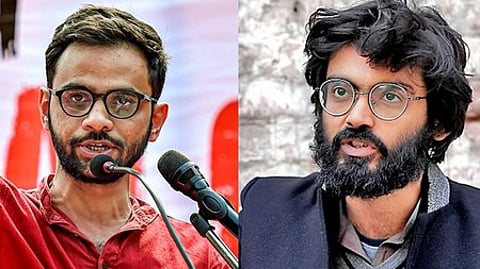

NEW DELHI: The Supreme Court on Monday denied bail to Umar Khalid and Sharjeel Imam in the Delhi riots larger conspiracy case. The court observed that the materials showed a prima facie case against them under the Unlawful Activities (Prevention) Act, 1967.
The top court, however, ordered the release of five other co-accused in the case -- Gulfisha Fatima, Meera Haider, Shifa Ur Rehman, Mohd. Saleem Khan and Shadab Ahmed -- after drawing a clear distinction in their alleged roles. It imposed 12 conditions on them before releasing them on bail.
Refusing to grant bail to Khalid and Imam, the court observed that the appellants played a central and formative role in the alleged offences, attracting the statutory restrictions. The court said it was not persuaded that the continued period of incarceration had crossed the threshold required under Section 43D(5) of the UAPA to warrant the grant of bail.
A two-judge bench of the apex court, headed by Justice Aravind Kumar and also comprising Justice NV Anjaria, pronounced the verdict in the appeals filed by all the accused persons in the 2020 Delhi riots larger conspiracy case.
The top court had reserved the judgment on December 10, after hearing in detail the arguments from the Solicitor General Tushar Mehta, Additional Solicitor General (ASG) S V Raju. senior law officer for Delhi police. and senior advocates Kapil Sibal, Abhishek Singhvi, Siddhartha Dave, Salman Khurshid and Sidharth Luthra for accused persons.
"The bail adjudication requires court to look at what is attributed to each accused, and whether continued detention serves a legitimate purpose and it does not dismantle the prosecution's case. Thus, differentiation is a constitutional discipline imposed. Umar Khalid and Sharjeel stand on different footing, and it can't be ignored in terms of parity and culpabilty," said the top court in its verdict.
The court, before passing the judgment, also considered several key aspects in the case, including the right of personal liberty, prolonged incarceration and others.
"The constitutional court can't ignore Section 43D(5) which represents a legislatime judgment and when prosecution material prima facie disloses offence, statutory restriction must prevail and if not, liberty must prevail," it said.
The court clarified that the bail is not a forum for evaluating defences. Judicial restraint is not an abdication of duty. The correct application requires the court to undertake a structured enquiry. Whether the enquiry discloses prima facie offences. Whether the role of the accused has a reasonable nexus to the commission of the offence.
"Article 21 occupies a central space in the constitutional scheme. Pre-trial incarceration cannot be assumed to have the character of punishment. The deprivation of liberty will not be arbitrary. The UAPA, as a special statute, represents a legislative judgment as to the conditions on which bail may be granted in pre pre-trial stage," the court added.
All the accused persons have been under custody for over five years in a case in which they are facing serious allegations of committing offences under the Unlawful Activities (Prevention) Act.
The Delhi police, strongly opposed the bail pleas of activist Umar, Sharjeel and others, and argued that the February 2020 riots were not something spontaneous, but an "orchestrated, pre-planned and well-designed" attack on India's sovereignty.
ASG Raju had submitted and rejected the petitioner’s (accused persons) argument that repeated charge sheets had prolonged the trial. He asserted that the prosecution was prepared to argue at every stage.
Raju then had argued and detailed Khalid’s alleged role in the Delhi riots, presenting a chronological account of events since December 2019, when public opposition to the Citizenship Amendment Act, 2019, was escalating in the capital. He relied on speeches and witness statements recorded under Section 164 of the Code of Criminal Procedure, 1973.
"Khalid violated the order against unlawful assembly under Section 144 of the Indian Penal Code, 1860, in December 2019. There are evidence of secret meetings and text messages from that period, which allegedly demonstrated an involvement in organising chakka jams (road blockades)," he had argued.
Adding that the accused were culpabale in commiting the offences, Raju further had added that Khalid was constantly updated about developments by co-conspirators during the riots, using these instances to argue that the Delhi riots conspiracy was planned months before the incident.
Moreover, he refuted arguments about Khalid’s absence from specific locations, stating that call detail records (CDR) placed him at key sites. Raju also stated that Khalid had attempted to flee during that period by relying on flight ticket details.
Senior Advocate Siddharth Dave, appearing for Sharjeel Imam, had argued that speeches would, at most, constitute “unlawful activities” defined under Section 13. Raju quickly responded that the speeches should indeed be deemed terrorist acts under Section 15, as the resulting riots had led to the blockade of several areas and, consequently, had affected the “economic security” of the country, a criterion that falls under the definition of a terrorist act.
All six accused vehemently denied their involvement and claimed innocence in the case, whereas the Delhi police opposed their bail and sought a direction from the top court to dismiss their pleas.
The Delhi High Court had rejected the bail pleas of these six accused, forcing them to knock on the doors of the apex court for relief.
These accused petitioners have moved the top court, against the Delhi HC's verdict of September 2, 2025, dismissing their bail applications. A division bench of the HC comprising Justice Naveen Chawla and Justice Shalinder Kaur had pronounced the judgment.
The riots took place in February 2020, following clashes over the then-proposed CAA. According to the prosecution, the violence had erupted following severe protests against the CAA and NRC. These protests had left 53 people dead and over 700 injured.
