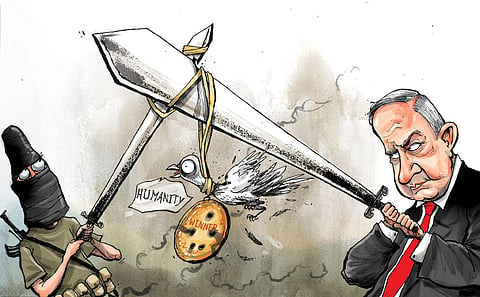

The Gaza war, now tapered into an awkward ceasefire, has left behind devastation beyond imagination. Israel fought with overwhelming force, Hamas remains battered but not erased, and the world once again confronts the familiar question that has shadowed the region for decades: who really gains when the dust settles?
It may sound counterintuitive, but in the political and psychological sense, Hamas appears to have secured what strategists call ‘perceptual victory’, even as Gaza lies in ruins.
The October 2023 attack by Hamas was a meticulously planned but morally indefensible act of terror that shocked even those sympathetic to the Palestinian cause. The deliberate targeting of civilians is beyond justification. Hamas likely believed that only such a drastic act could revive global focus on a fading cause.
With the Abraham Accords expanding and Saudi-Israel normalisation on the horizon, the Palestinian issue risked permanent marginalisation. Strategically, the perception was correct; the method, however, remains unacceptable to the civilised world.
For Israel, the response was shaped by two impulses. The first was the national need for retribution—a visceral reaction to the scale of the assault, necessary to preserve deterrence and restore confidence among its citizens.
The second was political. Benjamin Netanyahu’s survival depended on projecting absolute resolve. A restrained response would have been interpreted domestically as weakness and internationally as loss of moral ascendancy. Yet, the ferocity of the Israeli retaliation, which blurred the line between combatant and civilian, ended up achieving the reverse—moral erosion in the eyes of much of the world.
Had Israel opted for a more selective approach—differentiating clearly between Hamas’s armed elements and Gaza’s civilian population—the story might have been different. But even then, the outcome may not have served Israel’s core objectives. Precision targeting alone could hardly dismantle an organisation deeply embedded in a social and religious network. In asymmetric warfare, the stronger side is always constrained by its strength. Ethical restraint can appear a weakness; overwhelming force breeds resentment. Israel faced an unenviable choice, as either path would have led to strategic frustration.
What followed was a campaign that achieved tactical success but strategic ambiguity. Hamas’s command structures were disrupted but not destroyed. Its fighters melted away into the urban maze. Its political narrative, meanwhile, gained renewed currency.
Images of devastation and humanitarian suffering flooded global consciousness, shifting public opinion in many countries away from Israel’s narrative of self-defence. The international community’s sympathy, initially with Israel, slowly tilted towards the Palestinian people. This shift was not about ideology, but about the human cost that became impossible to ignore.
The paradox of modern conflict is clear. Wars are judged less by territory gained and more by legitimacy sustained. Israel’s moral authority, once grounded in its democratic ethos and history of persecution, now faces growing challenge. Much of the Global South views Gaza through the lens of excessive force, while younger Western audiences question Israel’s proportionality. Hamas, though condemned for terror, gains indirectly from this erosion of Israel’s moral standing.
This dynamic is not new. History shows weaker actors often extract long-term advantage from apparent defeat. In 1973, Egyptian President Anwar Sadat launched Operation Badr, also known as ‘Sharara’ or spark, knowing Egypt could not win a protracted war. Yet, by regaining limited ground and restoring Arab confidence, he transformed the political reality, paving the way for the Camp David Accords.
The Liberation Tigers of Tamil Eelam in Sri Lanka were annihilated in 2009, yet their cause continues to echo across the Tamil diaspora. In both cases, physical defeat could not extinguish the emotional and political narrative. Hamas’s endurance, despite ruin, follows a similar pattern.
The regional consequences are also significant. The war has disrupted the momentum of Arab-Israeli normalisation. Public anger in Arab capitals constrains governments from deepening ties with Israel. Iran’s influence through Hezbollah, Houthis, and other proxies has gained new legitimacy under the banner of ‘resistance’.
Türkiye and Qatar have positioned themselves as interlocutors, expanding their diplomatic weight. For Pakistan and others in the Muslim world, the conflict has revived calls for solidarity that had long receded into rhetoric. A Muslim Nato is also being spoken of. The Palestinian question, once peripheral, is once again at the centre of global debate.
For Israel, the aftermath offers little comfort. The cost to its image, economy, and social cohesion is profound. Protests over hostages, divisions within its polity, and fatigue among its reservists point to a society strained by perpetual mobilisation. The strategic environment it faces now is not of its choosing: a hostile northern front, a restless West Bank, and diminishing international patience. The dream of absolute security remains elusive.
For Hamas and similar movements, the path ahead will be one of recalibration rather than retreat. They will rebuild quietly, drawing strength from symbolism rather than structure. In a decade or two, another generation may rise under the same banner, propelled by the same grievances. This is the enduring tragedy of the conflict—cycles of retribution that produce neither victory nor peace. Israel will live with neither full war nor genuine peace, while Gaza’s people will remain trapped in despair.
The world must see this outcome not as a win for one side but as a collective failure of politics and humanity. Hamas’s methods are indefensible; Israel’s reaction proved counterproductive. The result is a temporary cessation of fighting, not a resolution. Yet, perception matters in geopolitics, and in that, Hamas has emerged as the side that forced the issue back to global attention. That is why, even amid destruction, it is viewed as the victor of this round—not for triumphing, but for enduring.
The Gaza war reaffirms a sobering truth. In the age of asymmetric conflict, wars are no longer decided solely by arms or alliances, but by narratives and endurance. Hamas may have paid an unbearable price and Israel may claim battlefield success, but neither has secured the future. The conflict pauses, not ends. As always in such situations, both sides lose—yet, by merely surviving, one side appears to win.
Lt Gen Syed Ata Hasnain (Retd) | Former Commander, Srinagar-based 15 Corps; Chancellor, Central University of Kashmir
(Views are personal)
(atahasnain@gmail.com)
