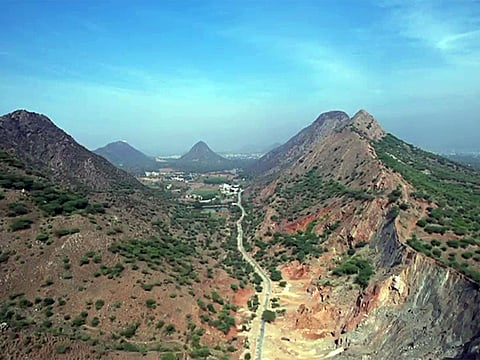

JAIPUR: A High-Powered Committee (HPC), constituted under the Supreme Court's directive to study the definition, environmental integrity, and conservation of the Aravalli mountain range, will visit the Aravalli regions of Delhi, Haryana, and Rajasthan from August 6 to 10.
The aim is to assess the ground realities about the balance between conservation and development and to provide scientifically grounded recommendations to the Supreme Court.
The Aravalli range had shot into national prominence last year in November-December when major protests had erupted over questions regarding the exact definition and height of Aravallis that could not be tampered with even for developmental reasons.
Despite the gravity of the issue and the scheduled visit of the HPC, the Rajasthan government is yet to appoint a nodal officer for this matter. Former CM Ashok Gehlot has slammed the Bhajanlal Sharma government for this delay and questioned its intentions.
Chaired by the Director General of the Indian Council of Forestry Research and Education (ICFRE), the committee will conduct a ground-level assessment of aspects concerning the environment, water resources, biodiversity, mining activities, land use, and the livelihoods of local communities during the field visit.
Following the field visits, multi-stakeholder consultation meetings will be held daily in the respective areas.
Participants will include environmentalists, conservation experts, voluntary organisations, mining leaseholders, project operators, farmers, local villagers, mine workers, experts from research institutions, and officials from various government departments.
The Supreme Court has asked the committee to seek suggestions from all relevant stakeholders and incorporate them into its report.
In this regard, the ICFRE has written to the Chief Secretary of Rajasthan, urging the appointment of a senior nodal officer and requesting that necessary administrative arrangements be ensured for the visit.
The letter notes that the Supreme Court constituted the committee on May 25, 2026. A letter requesting the appointment of a nodal officer had previously been sent to the state government on June 27; however, as no appointment has been made to date, a follow-up letter has now been re-issued.
Expressing displeasure over the government's failure to appoint a nodal officer for the matter despite the committee’s visit, former CM Gehlot posted on social media platform 'X', “Acting on Supreme Court directives, a high-powered committee will visit the Aravalli regions of Delhi, Haryana, and Rajasthan. This is a crucial opportunity for Aravalli conservation. However, it is a matter of concern and condemnable that the state government has not yet appointed a nodal officer, despite a letter being sent by the ICFRE on June 27.”
Gehlot asserts that the Aravalli range is not merely a mountain chain but a natural barrier preventing the encroachment of the Thar Desert. It is critical for the state's water sources, rainfall patterns, wildlife, and the livelihoods of millions.
Gehlot also pointed out, “In its manifesto, the BJP had promised to create a 'Green Corridor' for the Aravalli Hills to completely halt illegal mining, but now the situation is such that the government has failed to make even the basic administrative preparations for the Supreme Court committee's visit.”
Gehlot urged the government to immediately appoint a senior nodal officer to present the state’s case before the committee with the utmost seriousness.
He emphasised that the voices of local communities, farmers, and environmentalists must be heard during public hearings and that concrete action must be taken against illegal mining. "If the Aravallis survive, Rajasthan survives," he stated.
The high-powered committee will visit the Delhi, Gurugram, and Faridabad regions on August 6. On August 7, it will travel from Faridabad to Sariska, passing through Kotputli, Neem Ka Thana, and Khandela.
It will tour Sariska, Jaipur, and Ajmer on August 8. Visits to Ajmer, Beawar, Rajsamand, and Udaipur are proposed for August 9. On the final day, August 10, the committee will inspect the Udaipur, Pindwara, and Mount Abu regions.
An intense movement about the Aravalli hills took place during November and December 2025 to oppose the new 100-meter definition established by the Supreme Court on November 20, 2025. Environmentalists, farmers, and political parties had protested strongly.
On November 20, 2025, the Supreme Court of India had ordered that only landforms rising at least 100 meters above the surrounding terrain would be classified as Aravalli hills. Under this rule, thousands of smaller hills with a height of less than 100 meters would have fallen outside the scope of protection, creating a risk of illegal mining, groundwater crises, and severe environmental damage.
Protests regarding this issue gained significant momentum across several states from the last week of November 2025 through the end of December 2025. In view of the mounting public outcry, the Supreme Court stayed the definition of the Aravallis it had previously accepted and subsequently constituted an expert committee to review the matter.
