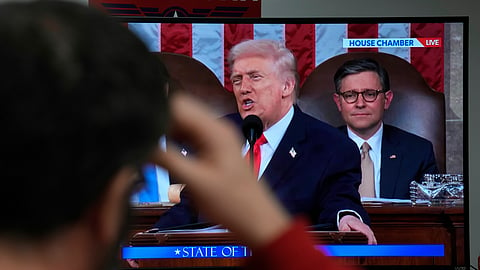

US President Donald Trump's first State of the Union of his second term was more of a political stress test of executive power, constitutional boundaries, and the durability of his own political brand.
The address came at a moment of vulnerability -- days after the Supreme Court of the United States struck down his signature global tariffs and amidst renewed tensions with Iran.
At nearly one hour and 47 minutes, the speech broke Trump's own modern record for length. But its significance lay less in duration than in what it revealed about Trump's governance approach in the second term, which is double down, sidestep constraints, and, more than anything else, reframe setbacks as leverage.
Perhaps, the most consequential subtext of the night was constitutional.
The Supreme Court's rejection of key tariff authorities would traditionally invite a president to seek legislative reinforcement. The Constitution assigns tariff power to Congress. Yet Trump explicitly discouraged lawmakers from codifying his trade regime.
"Congressional action will not be necessary," he said.
That line was as revealing as any in the speech. It signalled a continued preference for expansive executive manoeuvring over legislative compromise. Trump projected confidence that alternative legal means would suffice. Whether those pathways withstand scrutiny is uncertain. What is clearer is that Trump sees political value in maintaining unilateral flexibility, even if it perpetuates legal instability.
Then Trump predicted that tariff revenue could one day "substantially replace" the federal income tax, harping back to the pre-1913 era when tariffs were a primary revenue source. The historical analogy might be technically accurate, but fiscally implausible in a $30 trillion economy integrated into global supply chains.
Modern federal obligations, from defence to entitlements, dwarf the revenue base tariffs alone could realistically generate without dramatic consumer price increases. The promise functioned less as a policy forecast than as ideological signal-- burdens lifted from "the people that I love."
On domestic politics, Trump returned to his most reliable terrain of immigration. By spotlighting “angel moms” whose children were killed by undocumented immigrants, he reframed the 2026 midterms as a referendum on border security.
The message was blunt. Democratic victories would mean "reopening" America’s borders. Notably absent was any mention of controversial enforcement actions in states like Minnesota, where public opinion has been less favourable. As ever, Trump emphasised themes that mobilise his base while eliding areas of broader vulnerability.
Foreign policy issues provided the sharpest edges.
On Iran, Trump confronted an inconsistency that has lingered since he previously claimed to have “obliterated” Tehran’s nuclear capabilities.
Now, he argued, Iran is rebuilding, which means justifying the possibility of renewed strikes. He reiterated a preference for a deal, but coupled it with an unequivocal red line that Iran will not obtain a nuclear weapon. That certainly makes matters worse for the region as force remains the implied instrument.
Trump also reprised sweeping assertions of global peacemaking. He claimed to have “ended eight wars,” including averting nuclear conflict between India and Pakistan.
Similarly expansive was his assertion that the economy he inherited was disastrous but now “roaring like never before.”
For supporters, the speech demonstrated resolve. For critics, it underscored institutional strain.
As Trump moves deeper into his second term, the question is less whether he can command attention that he plainly can than whether he can convert spectacle into sustainable governance.
Tuesday night suggested that, for now, he remains more comfortable testing the boundaries of power than rebuilding the consensus. That seems neither his forte, nor his style.
