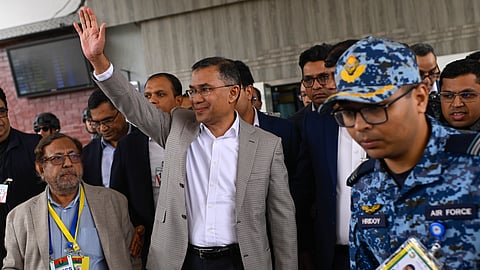

Sometime in December 2003, I had the opportunity to meet Tarique Rahman at his then de facto political office in Haowa Bhavan for the Dubai-based newspaper Gulf News.
The meeting was arranged by Giasuddin Al Mamun -- then considered Rahman's right-hand man -- who, most Bangladeshis knew, wielded enormous political power.
His mother Khaleda Zia, who died on December 30, 2025, was then the Prime Minister of Bangladesh, serving her second full five-year term. Rahman was being groomed as the future leader of the ruling Bangladesh Nationalist Party as its Senior Joint Secretary-General.
With this interview, I had hoped to introduce the future leader of Bangladesh to the UAE and the Gulf Cooperation Council, gain a better understanding of his idea of governance and how he planned to solve the problems of the country in the coming years. I remember asking him, "You are the future leader of the country. What type of Bangladesh do you envision to present to your people?"
He looked up, and clearly had started thinking about what his answer should be, as I threw another question at him.
"How do you see the infrastructure, utility, energy, power requirements and your thoughts on investment and meeting the future challenges, 15-20 years down the line," I asked.
I remember how his answer came from a completely different angle, a different direction from the expected.
He said, "I want people in the rural areas to develop poultry farms where they can grow chicken, egg, meat and fish and this way, they can become self-reliant and create a wealthy nation."
I then probed further, "What about investment in roads, highways, ports, airports, power, energy – to facilitate trade? How do you ensure adequate investment in these critical areas?"
But he didn't bite.
I had spent a good 15-20 minutes trying to get him to lay out a blueprint for the future so that there would be something substantial to write. Much to my disappointment, the glaring lack of any meaningful game plan by the man, who was destined one day to lead Bangladesh, made it difficult to piece together any coherent narrative. This was one interview that didn't see daylight!
So, more than 22 years later, I wanted to find the answers to the same questions that continued to linger, but this time from his speech delivered on his historic homecoming from exile on December 25, 2025.
Unlike most, Rahman's bloodlines are unique. He is the only leader in Bangladesh’s 54-year history, who has the distinction of being a direct descendant of a president and a prime minister, being as he is, the son of the charismatic President Ziaur Rahman and Prime Minister Khaleda Zia.
Can we expect that he was touched too by living, as he did, in the United Kingdom for 17 long years in exile? The UK where democracy is a byword, enabling him to finally understand the need to uphold the spirit of democracy.
Rahman's speech on his arrival touched upon an important area –- unity in nation building. He said he would work with all stakeholders for the development of Bangladesh, which is crucial for a country that remains deeply divided on political lines.
It must be said that the head of the interim government Professor Muhammad Yunus had a golden opportunity to unite the country. But during his 16-month rule, he has only widened and deepened the division.
In that context, Rahman's call for unity and his pledge to utilize the power of the youth has a very positive overtone.
Towards the end of his homecoming speech, when he quoted Dr Martin Luthar King's famous 'I have a Dream' remark, one was pleasantly surprised. Would there be a befitting follow through on Dr Martin Luthar King’s famous line?
One hoped to hear him say 'I have a vision'.
Instead, he said, 'I have a plan.'
"If this plan and these actions are to be implemented, then I will need the cooperation of every person present in this sea of people, and of all those who represent the democratic forces across Bangladesh. If you stand by us and support us, God willing, we will be able to implement this plan," he stressed.
What is Rahman's 'plan'? His speech simply didn’t go far enough. It didn't tell his countrymen enough. Too early perhaps, to lay it all out?
Or is this Rahman still the consummate politician playing his cards close to his chest? Or is he still several steps away, from evolving, from making the jump from politician to mature statesman. If his speech is any indication, the people of Bangladesh may have to lower their expectations from their next leader -- unless he has a surprise up his sleeve.
The nation has to wait, perhaps for the new Rahman to shed the past and embrace the present.
Bangladesh needs more than just 'a plan'. It needs dynamic vision. It needs a strategy for national development.
A plan might not be good enough.
(The author is Founder and CEO, Bangladesh Economic Forum)
