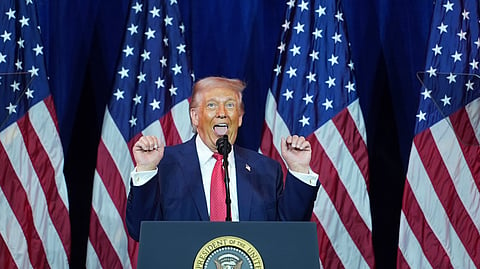

A proposed US Congressional bill that would impose steep tariffs and secondary sanctions of up to 500% on countries importing Russian energy could place India and China in Washington’s crosshairs, after US President Donald Trump appeared to give it the green light.
The move follows comments by Republican Senator Lindsey Graham, who said he met Trump at the White House on Wednesday, where the president approved the long-pending Russia sanctions legislation.
Senator Graham said the bill could be put to a vote as early as next week, though its prospects in Congress remain uncertain.
"This will be well-timed, as Ukraine is making concessions for peace and Putin is all talk, continuing to kill the innocent," Graham said in a statement, referring to Russian President Vladimir Putin.
The bipartisan legislation, titled the Sanctioning Russia Act of 2025, has been spearheaded by Senator Graham and Democratic Senator Richard Blumenthal. It would authorise the US to levy punitive tariffs and secondary sanctions on countries — including India and China — that continue to purchase Russian oil, gas, uranium and other exports.
The legislation has dozens of co-sponsors in the Senate, as well as a companion bill in the House of Representatives.
Supporters of the bill say the measures are intended to choke off funding for Russia’s military operations by targeting revenues from energy exports, which have remained resilient despite earlier Western sanctions.
Senator Graham had previously suggested that Trump backed the proposal, though it faced delays and resistance.
A White House official has now confirmed that the president supports the sanctions legislation. The White House had previously insisted on revisions to the sanctions package, including greater flexibility for Trump, though the official on Wednesday did not say whether any changes had been secured.
What the bill says
Introduced in the US Senate in January last year, the Sanctioning Russia Act of 2025 outlines a set of punitive measures linked to Russia’s near-four yea war in Ukraine. The bill would apply if the US president determines that the Russian government, or people acting on its behalf, are refusing to negotiate a peace deal with Ukraine, violating any agreement reached, launching a new invasion, or attempting to undermine or overthrow Ukraine’s government.
In such cases, the legislation requires the US to impose visa bans and asset freezes on specific individuals. These include the Russian president, senior military commanders and any foreign person found to be knowingly supplying defence equipment to the Russian armed forces.
The bill also calls for steep tariffs on Russian imports. It mandates duties of at least 500% on all goods and services imported into the United States from Russia. In addition, the same level of tariffs would apply to imports from countries that knowingly trade in Russian-origin uranium and petroleum products.
The legislation further directs the US Treasury Department to impose asset-blocking sanctions on financial institutions set up under Russian law and owned wholly or partly by the Russian state. It would also target financial institutions that carry out transactions with those entities.
Finally, the bill requires the US Commerce Department to ban the export, re-export or transfer of US-produced energy and energy-related products to or within Russia.
Why it matters for India
India has sharply increased its purchases of discounted Russian crude since the start of the war in Ukraine, turning Russia into one of its largest oil suppliers. At times, Russian oil has accounted for around 35–40% of India’s total crude imports, up from about 0.2% before the conflict.
Trump has repeatedly criticised India’s continued purchases of Russian oil. In August, his administration imposed an additional 25% levy on Indian imports, taking total US tariffs on Indian goods to 50% — among the highest imposed on any major trading partner.
India has defended the imports, saying they are essential to meeting domestic energy demand and shielding consumers from price volatility. New Delhi also maintains that its approach is guided by national interest.
Meanwhile, Russian crude continues to flow into India despite US sanctions on two major Russian oil companies, Rosneft and Lukoil, though volumes have fallen from earlier levels. Supplies have been sustained largely by India’s private refiners, which have adjusted operating strategies, as well as by sourcing oil from entities not directly sanctioned.
According to commodity analytics firm Kpler, India imported about 1.2 million barrels per day of Russian crude in December 2025, the lowest level since December 2022.
Under the proposed US legislation, countries found to be knowingly importing Russian-origin petroleum products could face tariffs of up to 500% on their exports to the United States. That could leave Indian exporters exposed to punitive trade measures.
Any decision by Washington to enforce such secondary sanctions could further strain India–US relations, which have deepened in recent years across trade, defence and strategic cooperation.
However, ties have faced turbulence in 2025, as trade disputes, immigration restrictions and geopolitical tensions have tested the relationship in ways not seen for decades.
India and China — the two largest buyers of discounted Russian crude — would be directly in the firing line. Their continued purchases have provided Russia with a crucial economic lifeline, helping to sustain military operations in Ukraine even as Western sanctions have tightened.
The wider economic impact could be significant.
A 500% tariff on Chinese goods, which make up a large share of US consumer imports, could drive up prices, disrupt already fragile global supply chains, and risk higher inflation and job losses in the United States.
India, meanwhile, could face reduced access to the US market at a time when it is seeking to expand exports in sectors such as pharmaceuticals, information technology and textiles.
