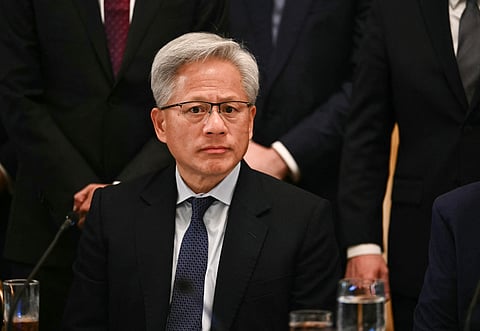

Jensen Huang resigned as Chief Executive Officer of Nvidia on Thursday, ending his 33-year run at the helm of the AI giant he co-founded in 1993, following revelations that he had two extramarital affairs, including one with a woman accused of spying for China.
The company's board said Huang had stepped down as president, chief executive and board member, with immediate effect.
Chief Financial Officer Colette Kress will serve as interim CEO while retaining her finance role. The board will consider both internal and external candidates for a permanent successor.
Huang's departure marks a dramatic leadership change at the world's most valuable semiconductor company, which has been at the centre of the global artificial intelligence boom.
The controversy intensified after reports emerged that Huang had an extramarital relationship with Alice Huang, a former senior executive at Singapore-based Megaspeed International, a major Nvidia customer.
US intelligence agencies reportedly suspected her of gathering information for Beijing. The allegations have raised concerns over potential national security implications and the security of Nvidia's technology and trade secrets.
Nvidia's board had earlier initiated an independent investigation into whether its founder and CEO had been targeted by a foreign intelligence operation. The company said at the time that it had no reason to believe that US national security or its proprietary information had been compromised.
Huang had also acknowledged being unfaithful to his wife in a message to employees, apologising to his family and colleagues and saying he took full responsibility for his actions.
The controversy took another turn after The New York Times reported that Huang had an extramarital relationship with Kimberly Powell, Nvidia's vice-president of healthcare, who reportedly reported directly to him. The report cited five people who had worked at the company.
Huang, 63, co-founded Nvidia in 1993 and has led the company since its inception. Under his leadership, the semiconductor firm transformed from a maker of graphics processing units (GPUs) primarily used in gaming into the world's leading supplier of chips powering artificial intelligence systems.
Nvidia's GPUs, particularly its data centre processors, have become critical to companies developing and deploying generative AI models, making the company a key beneficiary of the surge in global investments in AI infrastructure.
The leadership transition also comes amid concerns over the company's succession planning. Huang had not publicly named a successor, with analysts identifying Kress and senior engineering executive Ian Buck as possible candidates for an interim or permanent leadership role.
Kress joined Nvidia in 2013 and previously held senior finance positions at Microsoft, Cisco and Texas Instruments. She has been one of the company's most prominent executives, regularly appearing alongside Huang during quarterly earnings calls.
(With inputs from AP, AFP)
