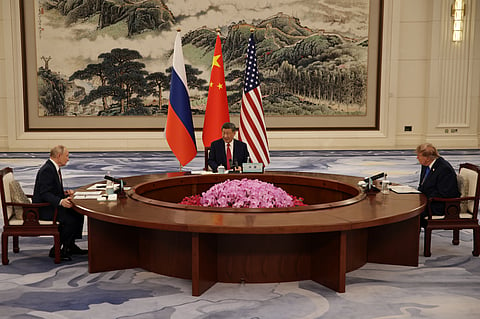

US President Donald Trump, Russian President Vladimir Putin and Chinese President Xi Jinping began an unprecedented trilateral meeting in China's southern city of Shenzhen on Thursday, bringing together the leaders of the world's three largest nuclear powers amid wars in Ukraine and Iran, growing geopolitical tensions and uncertainty over global security.
The meeting, held on the sidelines of the Asia-Pacific Economic Cooperation (APEC) summit at Kylin Villa, is being closely watched for its implications for the international order, particularly as Washington, Moscow and Beijing seek to assert their influence over major global developments.
The three leaders made brief opening statements before beginning their discussions. Trump described the gathering as an opportunity to make history, saying the United States, Russia and China were uniquely positioned to discuss reducing nuclear weapons and lowering the risk of their use.
"We are really making history," Trump said, adding that the three countries could work towards reducing the number of nuclear weapons in the world.
Xi, meanwhile, said that his trilateral meeting with his US and Russian counterparts was of "groundbreaking significance".
"The gathering of the leaders of China, Russia and the United States for the first time in history is of groundbreaking significance," Xi said.
China, the United States and Russia should "jointly safeguard world peace and stability", Xi Jinping told Donald Trump and Vladimir Putin.
Russian President Vladimir Putin told US President Donald Trump and China's Xi Jinping that their three countries shared an "interest" in resolving the Ukraine war and a "responsibility" for global peace and security.
"Our countries have many converging interests when it comes to resolving regional conflicts, including, of course, the conflict in Ukraine," Putin said in opening remarks at a landmark summit between the three leaders in Shenzhen.
He added they had a "shared responsibility for maintaining international peace and security" and that closed-door discussions would also touch on food and energy security -- both of which have been upended by the Iran and Ukraine wars.
The trilateral meeting is expected to cover nuclear disarmament, the wars in Ukraine and Iran, bilateral relations, international trade and emerging technologies, including artificial intelligence. However, analysts have cautioned against expecting any major breakthrough, given the significant differences between the three countries on several of these issues.
Nuclear arms control in focus
Nuclear arms control is among Washington's principal priorities for the meeting. Trump has repeatedly called for a new agreement involving the three countries, arguing that any meaningful arrangement to reduce nuclear weapons must include China alongside Russia and the United States.
The issue has assumed greater urgency following the expiry of the New START treaty between Washington and Moscow in February. The agreement, which provided the framework for limiting the two countries' deployed strategic nuclear arsenals, was the last remaining major nuclear arms control pact between them.
Trump has argued that a new agreement should bring Beijing into the negotiations as China's nuclear arsenal continues to expand.
However, Beijing has consistently resisted joining such negotiations, maintaining that the United States and Russia possess considerably larger nuclear stockpiles and must first reduce their arsenals.
Speaking to Fox News in Shenzhen, Trump cited figures of approximately 4,000 nuclear weapons for the United States, 3,800 for Russia and between 400 and 500 for China, while arguing that Beijing was rapidly expanding its capabilities.
The disparity in nuclear capabilities remains a major obstacle to any trilateral arms control arrangement, with China insisting that it should not be placed on the same footing as the two countries possessing substantially larger arsenals.
UN Secretary-General Antonio Guterres had earlier said that a meaningful commitment by the three leaders towards nuclear disarmament would be a significant achievement for the world.
Ukraine war and fears of sidelining Kyiv
The war in Ukraine is another major issue surrounding the meeting, although the extent to which it will feature in the discussions had remained uncertain ahead of the summit.
Washington had initially indicated that Ukraine might not be part of the trilateral agenda. Trump, however, subsequently said he intended to discuss ending the war with Putin and Xi.
The Kremlin had also said that the agenda was yet to be finalised, while acknowledging that it would be difficult to avoid discussing the conflict.
Russia's invasion of Ukraine, launched in February 2022, is approaching its fifth year, with diplomatic efforts to end the war yet to produce a lasting settlement.
The prospect of the three leaders discussing the conflict without Ukrainian President Volodymyr Zelenskyy or European representatives at the table has triggered concerns in Kyiv and across Europe.
Zelenskyy has warned against the possibility of the meeting turning into a modern-day Yalta conference, referring to the 1945 summit at which the Allied powers discussed the post-war settlement and spheres of influence in Europe.
Ukraine's Foreign Minister Andriy Sybiha had also cautioned that a meeting between the American, Russian and Chinese presidents could encourage Putin to continue the war.
European leaders have similarly maintained that decisions concerning European security cannot be made without Europe's participation.
The concerns have been reinforced by the possibility that Washington and Moscow could discuss a settlement favourable to Russia without securing Kyiv's consent.
Meanwhile, Russia and Ukraine exchanged fresh strikes ahead of the trilateral meeting on Thursday, underlining the continuing hostilities even as the diplomatic engagement got underway.
Iran war and energy security
The conflict involving the United States, Israel and Iran is also expected to figure prominently in the discussions.
The war has disrupted energy supplies and international shipping, with restrictions around the Strait of Hormuz contributing to concerns over global oil prices and economic stability.
China, a major economic partner of Iran, has sought to position itself as a diplomatic interlocutor and has hosted several regional leaders and diplomats in recent weeks in an effort to prevent a renewed escalation.
Trump said ahead of his bilateral meeting with Xi that both Washington and Beijing had a strong interest in ensuring the uninterrupted movement of energy through the Strait of Hormuz and preventing Iran from acquiring nuclear weapons.
"Both the United States and China have an interest in ensuring that energy flows through the Strait of Hormuz and that Iran cannot have a nuclear weapon," he said in prepared remarks.
The US president has also said that the three leaders would discuss efforts to end the conflict.
For China, the issue has direct economic implications, given its dependence on energy imports and its longstanding economic engagement with Iran. A prolonged disruption of shipping through the strategically important waterway could further affect global energy markets and supply chains.
Trump holds separate talks with Putin and Xi
The trilateral meeting followed separate bilateral engagements between Trump and the two leaders.
Trump met Putin earlier on Thursday, marking their first meeting since August 2025. The two leaders discussed the Ukraine conflict and bilateral relations, according to Kremlin foreign policy aide Yuri Ushakov.
Trump described Putin as a friend during their opening exchange, saying they had known each other for many years and expressing hope that their meeting could produce positive results.
The Kremlin subsequently described the bilateral meeting as having gone well, with Ushakov saying Putin left the discussions in an "excellent" mood. However, he indicated that no particularly significant announcements had emerged from the talks, as both sides were preparing for the trilateral engagement.
Trump also held discussions with Xi, their third meeting this year. The bilateral engagement lasted approximately an hour.
Trump praised his relationship with the Chinese president, describing their ties as special and saying that he did not expect major problems as long as both leaders remained in charge.
Xi said relations between Washington and Beijing had remained stable and improved, and expressed his commitment to working with Trump to steer bilateral ties in the right direction.
"We have established a new definition of a constructive China-US relationship of strategic stability, giving it new substance based on respect, fairness and reciprocity," Xi said.
Trade was among the key subjects discussed during their bilateral engagement. Trump said the trade arrangements and the Board of Trade established following their May meeting in Beijing had helped bring greater balance to economic relations between the two countries.
He also indicated that Washington wanted Beijing to increase its purchases from American farmers.
Trade, technology and the global balance of power
Beyond the immediate conflicts, the meeting comes at a time when the United States and China are attempting to stabilise their economic relationship following a prolonged tariff confrontation.
The two countries imposed steep tariffs on each other's goods during 2025 before reaching a temporary truce. The arrangement is due to expire on January 10, 2027, adding urgency to efforts to maintain economic stability.
Disagreements over agricultural purchases, rare-earth exports and access to advanced semiconductor technology remain unresolved.
Artificial intelligence is another emerging area of friction. Washington has sought to restrict China's access to advanced American AI chips, citing national security concerns, while Beijing has opposed what it describes as restrictions on its technological development.
The Shenzhen summit is particularly significant in this context, as the city is one of China's principal technology and manufacturing hubs.
The three countries also have competing strategic interests in the Asia-Pacific region, where tensions over Taiwan, maritime security and technological competition continue to shape diplomatic relations.
Concerns over a new world order
The gathering has also revived concerns that the three major powers could seek to determine the contours of a new international order without adequately considering the interests of smaller countries and regional powers.
The comparison with the 1945 Yalta conference has gained traction because of fears that the three leaders could discuss territorial disputes, security arrangements and spheres of influence without the participation of countries directly affected by their decisions.
The three countries, however, do not share the common strategic objectives that united the Allied powers during the Second World War. Their competing interests over Ukraine, Iran, trade, nuclear weapons and regional security could make any agreement difficult.
The meeting is also politically significant for Putin, whose international engagement has remained constrained since Russia launched its invasion of Ukraine in 2022. His participation alongside Trump and Xi offers Moscow an opportunity to reinforce its position as a major global power.
For Xi, hosting the two leaders provides an opportunity to project China's diplomatic influence and present Beijing as a key player in discussions on international security.
Trump, meanwhile, has portrayed the gathering as an opportunity for the three countries to work towards ending conflicts and reducing nuclear risks.
Although the outcome of the discussions remains uncertain, the unprecedented gathering marks a significant moment in global diplomacy, with its implications likely to extend well beyond the APEC summit.
