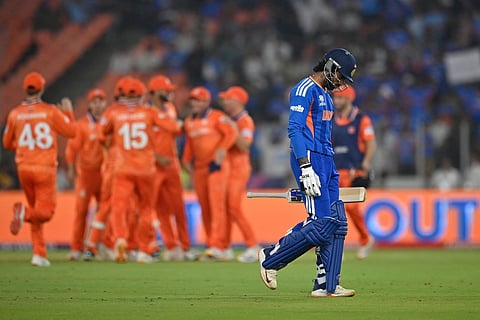

AHMEDABAD: Post the batting powerplay against the Netherlands on Wednesday, it was 51/2, with Tilak Varma and skipper Suryakumar Yadav in the middle. Despite the early dismissal of openers, India had managed to finish the powerplay strongly, but a bigger challenge awaited.
Through this tournament, the defending champions have struggled to sustain the momentum after the powerplay, especially against spinners. And it was something the opponents had taken note of. Netherlands had used spinners up front to get rid of Abhishek Sharma and Ishan Kishan, and they knew neither Surya nor Tilak had been fluent against spinners.
In came Colin Ackermann, who delivered a boundary-less seventh over. He helped halt the momentum, something Bas de Leede and Logan van Beek built on. The hosts lost momentum, going from 51/2 in six overs to 74/2 at the halfway mark. To be precise, they managed 25 runs in the 7-11 over window. And in the process, also lost Tilak. Surya, too, couldn’t kick on as he did against the USA and fell shortly after. Thankfully for India, Shivam Dube stepped up and took India close to 200, which helped them beat the Netherlands by 17 runs.
This phenomenon of slowing down after the first six overs is not a one-off for India. It has been a problem for them and Tilak and Surya are at the centre of it. Whenever they have batted together, teams have taken that as a cue to bring on spinners, and the duo have struggled to attack the tweakers. Netherlands did the same after watching the struggle against spin in Colombo. De Leede said as much after the match.
The numbers tell the same story. In the four matches so far, India have batted with a strike rate of 106.67 against spinners between overs 7-10. In these four overs, they have played 41.66 percent dot balls against spin, with a boundary every 8.5 deliveries. India assistant coach Ryan ten Doeschate acknowledged the issue against finger-spin post powerplay, but believed it was a trend across teams. He attributed it to pitches not being as flat and felt that it would become a differential point in the second half of the tournament.
“You think about IPL cricket and a lot of the bilateral series, the pace of the inning seems to just carry through from the powerplay. Whereas across all the games, maybe particularly in Sri Lanka, but certainly in India as well, you seem to get out of the blocks pretty quickly and then batting becomes slightly more difficult in the middle phase. Teams are getting really clever now. And obviously teams are bowling a lot of finger-spin to us with having so many left-handers in our line-up. That is a challenge,” the Dutchman explained.
Even if it is a general phenomenon, India’s troubles seems to be bigger than the rest. Till Wednesday, the overall batting record against spinners in the 7-10 over phase is much better than India's. So far, batters have a strike rate of 123.12 against spin in the four-over period and the overall dot-ball percentage (31.59) is ten percentage points lower than that of the co-hosts. Splitting it individually, Surya strikes at 81.48 against spin in overs 7-10 while Tilak’s SR drops down to 60 in this period.

Though this is the first time India are fielding as many left-handers in a T20 World Cup, the spin issue in the middle-overs is not new. In the 2022 T20 World Cup, India’s strike rate against spin in overs 7-10 was 104.76. The average was better (44), and the dot-ball percentage was lower (30.95), thanks to Virat Kohli's prolific running between wickets. However, India hit a boundary every 14 deliveries against spin in this period.
That is an issue the then captain Rohit Sharma and head coach Rahul Dravid identified and worked towards in the next couple of years. They understood the need to redefine intent and ensure India had the right players for the right phase of play. Enter Axar Patel and Dube. The two left-handers had specific roles to bash spin post powerplay. Hardik Pandya became the designated finisher in death overs.
The results were there to see in the 2024 T20 WC. In overs 7-10, India’s strike rate against spin increased to 124.5, with a boundary coming every 7.8 deliveries. And the key batter among the lot was Axar, who had a strike rate of 150, and Dube hit at 137.5 post Rohit’s 160 SR. It is impossible to ignore the game-changing knock Axar played in the final against South Africa after the early collapse.
In the two years that have followed, both Axar and Dube have only grown in stature and skill, but India have not nailed their entry points in this World Cup. They are yet to face a single ball of spin in the first ten overs. And that is largely because of Kishan's aggressive approach. However, as it did in the 2024 final, India might be in a tricky situation in the second half of the tournament. And when that happens, they will have to be ready to switch up and take a call on where Axar and Dube bat. The former also needs some time in the middle to gain some rhythm and confidence, rather than being sent in at No. 8, because they also have Pandya who can take down spinners in the death if needed.
Which is why it may be time for the team management to trust Axar, who is also the vice-captain, to do the job rather than using him just as a floater in crises. Because, as Ten Doeschate said, how India go against spinners could well be the differential factor in the Super 8s and the knockout stages of the tournament.