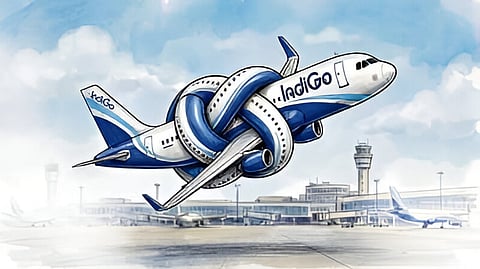

In what could be described as an aviation tsunami, market leader IndiGo’s brand reputation built on years of punctuality and reliability was reduced to mud this month as it cancelled hundreds of flights due to a mess of its own making. Chaotic scenes at airports of frantic fathers looking for food for their kids, mothers hankering for water, and the elderly barely able to stand in queues shook up the whole aviation industry. The situation has since stabilised though departure cancellations haven’t ended yet.
Various explanations have been offered to make sense of the unexpected turbulence – from lax planning to align with a new roster system for the crew’s night operations to conspiracy theories on ‘engineering’ the crisis to force the regulator to bend to its terms as the airline holds virtual monopoly. Curiously, IndiGo appointing an external aviation expert, Captain John Illson, to carry out a root-cause analysis of the massive flight disruptions could suggest that the airline itself isn’t completely certain as to where it went wrong. Or is it indulging in window dressing till the dust settles? The jury is out.
Recent images of its CEO Pieter Elbers apologising to Union civil aviation minister K Ram Mohan Naidu with folded hands went viral. With Elbers facing regulatory heat from the Directorate General of Civil Aviation (DGCA), IndiGo chairman Vikram Singh Mehta stepped in to reject charges of engineering the crisis or attempting to influence government rules.
The regulator took the first accountability hit as the DGCA dismissed four of its own Flight Operations Inspectors, who allegedly slept on the job though they were assigned exclusively to oversee IndiGo’s transition to the new roster system. The system is aligned with the international Flight Duty Time Limitation (FDTL) rules to enhance aviation safety. It also slashed the permitted volume of the airline’s daily flights by 10% to restore order.
Meteoric rise
IndiGo's rise had been nothing short of spectacular. Launched on August 4, 2006, it went on to become a virtual monopoly, capturing about 64% of India's domestic market, with a fleet exceeding 400 aircraft, predominantly from the Airbus A320 family, and around 2,200-2,300 daily flights, before the crisis erupted.
The airline’s success stemmed from high aircraft utilisation, punctuality (historically above 90%), and ruthless cost-efficiency. However, this dominance created vulnerabilities: a highly interlinked network where disruptions in one hub created ripples nationwide, and a lean manpower model with minimum buffers in case of crises. By November 2025, IndiGo's on-time performance had already declined to 67.7% from 84.1% in October, signaling emerging strains.
Rostering relook and FDTL
In January 2024, the DGCA revised the FDTL rules, setting out clear limits on the number of hours pilots could be on duty, with specific restrictions on night operations. It also mandated longer rest periods between flights and placed weekly and monthly caps on cumulative flying hours. Airlines were given until June 1, 2024, to implement them.
The framework was designed to bring India’s aviation regulations in line with international standards followed by authorities such as the Federal Aviation Administration (FAA) in the United States and the European Union Aviation Safety Agency (EASA). It required a complete overhaul of crew rostering practices and expanding pilot recruitment for full compliance. Framed by the International Civil Aviation Organisation (ICAO) and codified in India's Civil Aviation Requirements (CAR) Section 7, Series J, Part III, FDTL norms include maximum daily flight time of 10 hours during the day and eight hours at night.
Global experience with FDTL
Globally, FDTL is the gold standard for safety regulations. In the US, pilots cannot exceed 100 flight hours in 28 days or 1,000 hours annually. Rest requirements vary by duty start time. Europe's EASA requires that maximum daily flight duty is capped at 13 hours, with mandatory rest periods. In the Middle East, carriers like Emirates and Qatar Airways maintain larger pilot pools to absorb FDTL restrictions.
Industry pushback
The new FDTL rules made 22 changes, including enhancing the weekly rest for pilots from 36 to 48 hours, capping their daily night landings at two (down from six), extending ‘night’ hours to 6 am (instead of the previous 5 am), and mandating a Fatigue Risk Management System (FRMS) that allowed pilots to decline flights due to exhaustion, without inviting a penalty. Airlines were asked to log fatigue reports quarterly.
By March last year, the entire industry raised concerns about the operational impact of these changes. They argued that the transition period was too short. Through late 2024, carriers operated under the older framework despite regulatory prodding to expand pilot recruitment and adjust rosters.
A senior executive of a leading airline told this newspaper, “Any private company runs to make profits. Implementing these rules would force us to hire more pilots to run the same number of aircraft. We are speaking of huge salaries here and it will dent the profits to some extent.” As per a rough estimate, each airline needed to hire 20% more pilots for total compliance with the new rules.
The final push for FDTL came from the Delhi High Court, which on April 1, 2025 asked the DGCA to submit the dates for operationalising the new roster. That was when the regulator set the June 1 date for the first phase of the FDTL rollout and November 1 for the second phase.
Deadly December
The IndiGo crisis slowly began snowballing from late November. Of the 403 aircraft approved by the regulator, only 339–344 were operational by November-end. On December 1, when FDTL's phase 2 kicked in, IndiGo was unable to implement the new roster system, resulting in an unprecedented chaos affecting approximately 11 lakh fliers over a period of a week. By December 3-4, hundreds of flights were affected daily, with on-time performance dropping sharply to 8.5-19.7%.
The mess peaked on December 5, when approximately 1,600 flights were cancelled nationwide, including all departures from Delhi's Indira Gandhi International Airport until midnight. Major hubs like Bengaluru, Mumbai, Hyderabad and Chennai faced severe disruptions, resulting in chaotic airport scenes with stranded passengers and unclaimed baggage. Disruptions continued on December 6 with 850-1,000 cancellations, though IndiGo operated around 1,500 flights. On December 7, cancellations came down to about 650, with operations rising to 1,650 flights and on-time performance improving to 75%. However, cancellations persisted into the second week, with hundreds affected on December 8-11, tapering off progressively.
Why the logjam
The meltdown stemmed from the compounding of co-related issues, not a singular failure. IndiGo's aggressive 6% schedule expansion despite FDTL constraints, revealed inadequate crew buffering. Rostering software glitches compounded the disruption, as did the onset of winter, network congestion and minor technical hiccups, IndiGo said. Its lean operational model led to underestimation of a 10-15% crew shortfall.
Penalising IndiGo by grounding its entire fleet was out of the question because of its near domestic monopoly. Keeping ‘public interest’ in mind, the DGCA on December 5 accepted IndiGo’s request for a one-time exemption from stringent night duty regulations until February 10 to fix its operational gaps and implement the new FDTL system.
That regulatory lifeline was panned by aviation experts and critics, who saw it as caving to IndiGo's market dominance. The Delhi High Court rebuked the government on December 10 for its inaction, questioning surge pricing by rivals, and scheduling a contempt hearing on December 15 following a petition against the DGCA allowing the aviation major to wade past its FDTL deadline.
Aviation safety consultant Captain Mohan Ranganathan told this newspaper, “IndiGo has exerted enormous influence over the DGCA in the past. They took the whole exercise of implementing the FDTL lightly and thought they could get away with it like they had done so for many issues in the past."
Competitors unaffected
Other domestic airlines like Air India, Akasa Air, and SpiceJet maintained cancellation rates below 5% and near-normal operations. Their preparation for phase 2 of FDTL was also spot on. In contrast, IndiGo's dominant position and interconnected hub-and-spoke model amplified disruptions across the network, leaving little margin for error in tight rostering.
Its competitors with lesser market shares and regional operations had greater flexibility in scheduling flights. They reduced schedules, invested in data analytics, and accelerated hiring. Akasa added over 200 pilots in late 2025. Air India began hiring Captains and Flying Officers as soon as it officially took over the airline two years ago, said a spokesperson. “We went all out to recruit pilots ... we understood that the new roster would require a massive increase in operational crew.”
Captain Sam Thomas, president of the Association of Indian Pilots (ALPA), accused IndiGo of ‘slot hoarding’ across airports. Slot hoarding involves pre-booking excess slots at runways for take-off and landing in order to block them for their competitors.
Whistleblower’s charges
An open letter from an IndiGo whistleblower pilot on December 11 summed up the mood inside the corporate house. "IndiGo didn’t collapse in a day. This downfall was years in the making...when night duties were doubled, when new rules were implemented, when leaves were taken away. And the messaging from the top? You’re lucky to have a job.”
A representative on behalf of IndiGo pilots told this newspaper how experienced pilots were lured by IndiGo from competitors in 2005 with the promise of generous salaries that were substantial for 2005 (₹1.85 lakh for First Officers, ₹3.6 lakh for Captains), but as the fleet expanded those assurances eroded. He alleged unpaid ‘deadhead’ flights (pilots flying as passengers to reach the bases of their flights to operate them), minimal salary growth over 15 years, and worsening schedules after 2023 when IndiGo became the market behemoth. Reports of stress-related health issues and ignored appeals to the management followed, with insiders warning of deeper unrest if conditions did not improve.
“The first major broken promise was the no layovers guarantee. Pilots were stranded in distant cities after flying without extra compensation. Deadhead flights became mandatory and deadhead compensation was set at the lowest market rate. Delhi-based pilots could be sent to Mumbai for a flight and then immediately deadhead back, all unpaid. Salaries rose just 15% over 15 years,” he alleged.
Road ahead
The IndiGo crisis underscores aviation's tightrope: safety versus capacity. Its market dominance means disruptions have a ripple effect. Aviation experts have urged caution, with some warning that the carrier may not meet the February deadline on full FDTL implementation. As for the airline, it has deep pockets and is expected to weather the storm. Significantly, IndiGo promoter and managing director Rahul Bhatia continues to remain silent. And the regulator hasn’t found it fit to question him.
