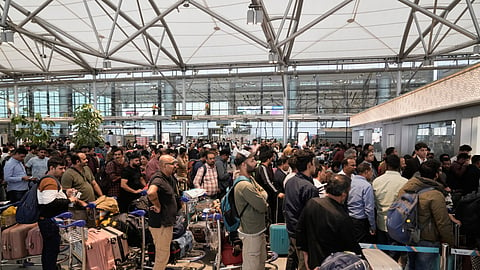

It was a crisis like no other in the annals of Indian aviation.
The sky bled IndiGo as over 4000 flights were cancelled in a week between December 2-8.
More than 10 lakh passengers were left stranded at airports across India, finding their lives cruelly interrupted.
What led to the meltdown at India's biggest airline—one that commanded over 64% of market share and prided itself on its on-time performance?
Was it hubris and irresponsibility, as some experts like the Air Deccan founder Captain Gopinath believed?
Did it stem from IndiGo attempting to bend the Directorate General of Civil Aviation (DGCA) to their will, as some pilot associations alleged?
Or was it simply IndiGo being too lackadaisical, despite receiving sufficiently advance notice of the new Flight Duty Time Limitations norms? With pilots being granted 48 hours of continuous rest as opposed to 36 hours earlier, wasn't the math done properly?
Numbers shared suggest that the pilot shortage alone couldn't have caused such a severe disruption. IndiGo was short by only 65 senior pilots (2422 Captains required, 2367 available) and had enough co-pilots on their rolls.
The airline continues to insist it was no single reason but a host of issues that built up into a perfect storm and knocked them down during those chaotic days.
As the answers are being sought, The New Indian Express pieces together the crisis that soared out of control while soft landing you where the story now stands.
A vision for a better tomorrow
January 2024 to November 2025
The first moves were made in a new year that saw new norms being laid to ensure flights adhered to the highest global standards.
The key change was the DGCA tightening rest rules for pilots.
By the time Phase 2 norms kicked in on November 1, 2025, the requirements were as follows:
* Weekly rest for pilots was raised from 36 to 48 continuous hours.
* Night duty was redefined to the longer 00:00 to 06:00 window.
* Permissible night landings per pilot were reduced from six to two.
* Also, no pilot could operate for more than two consecutive nights.
All airlines needed to get their math right from then on.
Why on this day of all days!
December 2
The IndiGo crisis suddenly sprung to life a month and a day after the implementation of the Phase II norms. But why oh why! At this stage, it remains a question demanding a convincing answer.
All of India took note as passengers began complaining about the delays that hit major metro airports.
Low visibility and operational issues were stated to have been the reason behind Day 1 of disruptions.
The number of estimated cancellations: 150+.
Travellers across India had begun to feel shaken.
The mushrooming
December 3
By now, the crisis was gaining a life of its own.
There were nearly 200 cancellations on the day.
IndiGo acknowledged the widespread disruptions in a press release, citing multiple contributing factors.
December 4
The day saw 300+ cancellations as the Association of Indian Pilots blamed the IndiGo management for triggering the meltdown.
The DGCA, meanwhile, issued a summons to IndiGo to present the facts.
IndiGo CEO Pieter Elbers released a letter, apologising for "not living up to the promise" of good service.
The airline warned that normalcy may not return until February 2026 and began planning a scale-down of flights.
If passengers had been shaken earlier, they were now both shaken and stirred.
Crescendo
December 5
Over 1000 flights were cancelled by IndiGo on the day, triggering an aviation emergency.
With IndiGo cancelling all flights on certain routes, some ticket prices shot up beyond Rs 1 lakh on booking portals.
The crisis spiralling out of control forced the DGCA's hand and they announced that they were rolling back their Flight Duty Limitations rules till February 2026.
IndiGo CEO Elbers insisted that despite this move, normalcy would return only by December 10–15, countering Civil Aviation Minister Ram Mohan Naidu's claim of a three-day recovery.
Firefights and firefighting
December 6
With the crisis continuing to fester, the Indian Railways lined up extra trains in a bid to help.
At airports, the flight chaos hadn't abated with as many as 850 cancellations.
The Centre ordered IndiGo to clear all pending refunds or face "immediate regulatory action". It also capped airfares amid price spikes.
The DGCA, meanwhile, issued a show-cause notice to IndiGo.
A political storm brewing over the issue too intensified with the Congress blaming the government and CPM demanding a Joint Parliamentary probe.
December 7
Cancellations declined but pressure mounted on IndiGo.
The airline processed ₹610 crore in refunds and delivered 3,000 lost baggage items.
The DGCA, for its part, gave CEO Elbers and Accountable Manager Isidro Porqueras 24 more hours to respond to show-cause notices.
Opposition and stock market land punches
December 8
The opposition demanded an explanation in Parliament.
At the bourses, the IndiGo stock had an outing to forget, plunging 8% intraday.
The day saw 500+ flight cancellations.
Union Aviation Minister Naidu in Rajya Sabha stated that "the IndiGo crisis occurred due to problems in its crew rostering and internal planning systems".
December 9
The Centre forced a course correction, ordering a 10% reduction in IndiGo's winter schedule.
A more confident IndiGo shrugged off the news and surfaced to claim that it was "back on its feet" and stabilising operations.
Simmering on
December 10
Around 220 cancellations happened despite the recovery efforts.
IndiGo announced it has processed ₹827 crore in refunds for cancellations up to December 15.
"The disruptions of last week did not happen because of any deliberate action. They happened because of a combination of internal and unanticipated external events including minor technical glitches, scheduled changes linked to the start of the winter season, adverse weather conditions, increased congestion in the aviation system, and implementation of and operation under the updated crew rostering rules. This is not an excuse," Chairman of the airline's board Vikram Singh Mehta said in his defence note.
December 11
IndiGo CEO Elbers appeared before DGCA to submit a detailed report.
The airline also announced ₹10,000 vouchers for passengers stranded between December 3–5.
The DGCA, meanwhile, began on-site monitoring of IndiGo's operations, refunds, and processes.
December 12
The DGCA suspended four Flight Operations Inspectors.
Minister Naidu said that capping airfares year-round is neither practical nor in the long-term interests of the civil aviation sector.
IndiGo engaged an external aviation expert for a comprehensive review and root cause analysis.
This is where things currently stand at the moment.
The end game is still waiting to play out. At The New Indian Express, we are tracking every step to understand why India's biggest airline faced such widespread operational failures.
Along with IndiGo, the DGCA too has questions to answer, including the vitally important one of why it failed to monitor the implementation of the new Flight Duty Time Limitations rules at India's biggest airline. When IndiGo had been allowed to grow into a monolith of this proportion, this certainly was a grave miss.
