
Is IndiGo too big to fail? Are they guilty of holding the country to ransom?
These are questions that must be asked after the airline's breathtaking ascent and the chaos that its extraordinary domination of the aviation sector has unleashed over the past few days. On Friday afternoon, even the government body was forced to yield to the giant of our skies and roll back rules for added safety temporarily.
After its launch in 2006, IndiGo mushroomed into India's largest airline by pursuing a disciplined low-cost model, high aircraft utilisation, and rapid fleet expansion. Today, IndiGo operates around 2,300 flights every day to 137 destinations, including 94 domestic and 43 international cities, supported by a fleet of 418 aircraft. With an almost 65% share of India's domestic market, it is not just a major airline—it is the backbone of Indian air travel.
In comparison, Air India operates barely 150 domestic flights daily, and the entire Air India Group, including international operations, manages between 500 and 600 flights a day. IndiGo's scale is unmatched, and its reliability has shaped travel patterns, ticket pricing, and passenger expectations across the country.
This is precisely why the events of early December 2025 came as such a shock.
The Directorate General of Civil Aviation (DGCA) had fully enforced the revised Flight Duty Time Limitations rules on November 1. But on December 2, IndiGo began claiming that they were unable to adapt their rosters quickly enough. The disruption was immediate and severe: more than 1,500 IndiGo flights were cancelled over the next three days.
Friday alone saw 1,000 flight cancellations and on-time performance of Indigo plummeted to 18% with all 235 flights from Delhi being cancelled. This was unprecedented.
Saturday too has not been immune to the chaos, with 800 IndiGo flights being cancelled.
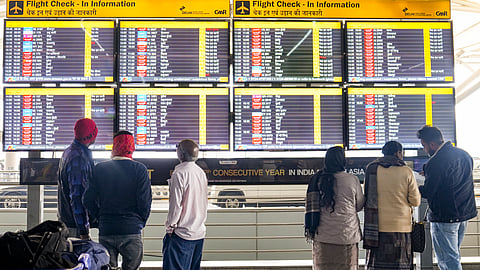
Passengers were stranded, queues stretched across terminals, and the country witnessed how vulnerable its aviation network becomes when its largest airline stumbles. Airfares skyrocketed as much as tenfold on certain routes. Flight booking platforms even listed one-stop air tickets priced above the Rs 1 lakh mark!
The rule that ended up being blamed
To understand the depth of the crisis, one must examine the Flight Duty Time Limitations rules themselves.
Updated by DGCA in January 2024, based on International Civil Aviation Organisation recommendations, court directives, and fatigue-related safety investigations, the Phase II norms that came into force on November 1, 2025 significantly tightened rest and duty requirements. Weekly rest was raised from 36 to 48 continuous hours; night duty was redefined to the longer 00:00 to 06:00 window; permissible night landings per pilot were reduced from six to two; and no pilot could operate more than two consecutive nights.
Airlines were also mandated to submit quarterly fatigue reports, reinforcing the fact that fatigue is a proven threat to flight safety worldwide. These rules were designed to bring India in line with global safety standards and to protect both crew and passengers. However, compliance hit IndiGo particularly hard.
With 2,300 flights a day, tight winter schedules, and an already stretched pilot workforce, the airline had very little margin to absorb the increase in rest hours and limitations on night operations. When the new rules took effect, many pilots became unavailable almost instantly because their rosters violated the updated rest requirements. Bottlenecks emerged around night landings, fog-related delays worsened the situation, and technical issues—including software snags on some A320 aircraft—added to the chaos.
Winter operations during the peak travel season leading to an increase in the number of flights could also have played a part. Put simply, IndiGo did not have enough rested, certified, and roster-compliant pilots to sustain its massive operations.
The scale that once gave IndiGo a competitive edge suddenly became a liability.
Failures galore
The first inkling of the looming crisis should have come to those at the top in November when 1232 flights were cancelled. 755 of these were due to crew and Flight Duty Time Limitation constraints, according to an official release by the Directorate General of Civil Aviation (DGCA).
A significant share of responsibility for what went wrong lies with IndiGo's management. The airline had nearly two years of notice regarding the Flight Duty Time Limitations changes, but appears to have underestimated their operational impact.
For years, IndiGo depended on very high pilot productivity, aggressive scheduling, and minimal buffers—an approach that works in normal circumstances but collapses when regulatory norms tighten. A company operating 65 percent of India's domestic capacity should not have been caught unprepared in this manner by a safety rule that was announced long in advance.
By stretching its manpower thin and relying on the assumption that compliance could always be managed through rostering adjustments, IndiGo exposed itself—and the country—to a preventable crisis. Dominance in the aviation market brings responsibility, and in this case, the airline's scale fostered complacency.
The regulator too is not without fault. Intentions of the aviation regulator DGCA, headed and run by bureaucrats rather than aviation experts, were correct. Fatigue is a serious safety issue, but the timing and manner of implementation reflected bureaucratic rigidity rather than operational sensitivity.
Enforcing Phase II of the Flight Duty Time Limitations norms in the middle of winter, when delays, fog, and peak travel loads are expected, was bound to strain the system. Better coordination, phased transition planning, or a more realistic compliance timeline would have mitigated the shock. Aviation regulation must be firm, but also predictable and calibrated to operational realities.
What about the lack of pilots?
In my view, the DGCA’s statement that IndiGo was short of only 65 pilots (2422 required to 2367 available) does not convincingly explain the scale of the disruption. For an airline of IndiGo’s size, with hundreds of aircraft and a multi-layered crew management system, such a relatively small shortfall should not logically result in a thousand cancellations in a day as it did on Friday.
This disproportionate impact suggests that there may be deeper internal issues at play—perhaps a serious scheduling failure, a breakdown in coordination, or even a subtle form of pushback by the workforce.
And considering IndiGo’s dominant position in the market, it is also possible that certain management strategies or misjudgments may have allowed the situation to spiral. Overall, the crisis appears far too large and sudden to be fully explained by the idea of "65 missing pilots" alone.
Ripples cast by IndiGo’s disruptions
A sudden shift that affects the country's largest airline inevitably casts ripples through the entire sector as it eventually did. Once the crisis spiralled, the DGCA moved to soften the blow by granting temporary relaxations. It allowed up to six night landings per pilot until February 2026, modified rest interpretations, and offered IndiGo time till then to stabilize its schedules.
These steps might have temporarily slowed the disruption, but they do not resolve the structural issues. India needs more pilots, better rostering systems, consistent fatigue monitoring, and closer alignment between regulatory expectations and airline capabilities.
The repercussions of IndiGo's disruption extended far beyond airport terminals.
As mentioned earlier, airfares surged sharply as capacity dropped, disproportionately affecting business travellers, last-minute flyers, and families traveling during the winter season. Tourism and corporate mobility suffered, and other airlines struggled to handle the sudden overflow of passengers. The morale of IndiGo’s staff also took a hit, as ground personnel and cabin crew bore the brunt of passenger anger despite having little control over scheduling decisions.
Given IndiGo's dominance, its instability reverberated across the aviation ecosystem, impacting the economy more widely than any other airline could.
Learnings from military aviation and the crisis itself
A useful comparison can be drawn with military aviation. Unlike commercial airlines, military flying follows strict discipline, exhaustive documentation, predictable work cycles, and non-negotiable training standards. There is no pressure to maximise utilisation or squeeze efficiency out of every available minute.
The contrast highlights a critical reality: civilian aviation, especially when driven by market forces and shareholder expectations, can drift into unsafe territory if fatigue, manpower planning, and regulatory compliance do not receive the seriousness they deserve. IndiGo's crisis is a reminder that safety and reliability require military-grade discipline even in civilian operations.
Passenger safety, thankfully, has not been compromised. In fact, these cancellations reduce the risk of fatigue-induced errors in the cockpit. But the long-term implications are significant.
This crisis could prompt airlines to reassess crew utilisation models, increase pilot recruitment, strengthen training pipelines, invest in fatigue-tracking technology, and adopt more realistic scheduling practices—particularly during winter.
It could also push the DGCA to refine its regulatory processes by consulting more widely with industry stakeholders and anticipating operational bottlenecks before policies become binding.
Ultimately, IndiGo's crisis is more than a scheduling failure; it is a structural warning to one of the world's fastest-growing aviation markets. Airlines cannot expand endlessly without strengthening manpower and safety systems.
Regulators must enforce safety robustly, so passengers are not left at the mercy of sudden systemic failures.
India, aspiring to be a global aviation hub, must build a framework in which growth is matched with governance. If this crisis leads to deeper reforms—at IndiGo, within DGCA, and across the sector—Indian aviation will emerge stronger, safer, and more resilient. If not, this may be only the first of many disruptions in the years ahead.
(Wing Commander A Mahesh (Retd) was a flight engineer with IAF and is a keen follower of the latest developments in the aviation industry.)
