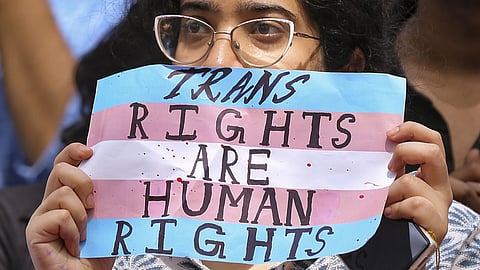

Parliament recently passed the Transgender Persons (Protections of Rights) Amendment Bill, 2026 amid stiff opposition from supporters and members of LGBTQIA+ community, including activists and students. India has at least two million transgender people. While the government says the narrowing of definition in the new amendments will make welfare benefits more accessible while preventing exploitation and trafficking, critics see it as exclusionary, as it negates the self-identification dictum set by the Supreme Court in its landmark 2014 ruling and undermines dignity and autonomy.
The watershed moment for the fight for transgender rights came on April 15, 2014, when a two-judge bench of the Supreme Court comprising justices A K Sikri and K S Radhakrishnan recognised the community as a third gender along with male and female.
The 2014 judgment
On April 15, 2014, the Supreme Court said, “eunuchs, apart from the binary gender, be treated as a ‘third gender’ for the purpose of safeguarding their rights under our Constitution and the laws made by Parliament and the State Legislature.” The court went on to direct the Centre and states to take steps to treat them as socially and educationally backward classes and extend reservation for admission in educational institutions and for public appointments.
“Recognition of transgenders as a third gender is not a social or medical issue but a human rights issue. Transgenders are also citizens of India. The spirit of the Constitution is to provide equal opportunity to every citizen to grow and attain their potential, irrespective of caste, religion or gender,” the court said in its ruling on a petition filed by the National Legal Services Authority (NALSA). The judgment recognised that sex identity cannot be based on a mere biological test but must take into account the individual’s psyche.
NALSA had filed the petition in the Supreme Court in 2012, seeking equal rights for the group, highlighting the discrimination they face even in hospitals. The court said that the absence of any law, which recognised transgenders as a third gender, could not be the ground of any discrimination in education or employment. The 2014 judgment had also recognised transgender identity and laid down that “self-determination of gender is an integral part of personal autonomy and self-expression”. The verdict stressed on self-identification as the most important right of the transgender community.
By virtue of this verdict, all identity documents, including birth certificate, passport, ration card and driving licence began recognising the third gender. The top court further directed the Central and state governments to chalk out social welfare schemes for this community and to run a campaign to improve awareness in the society. The awareness should be aimed at erasing the stigma regarding the third gender community, the court said.
Hailing the verdict, India’s former Attorney General, Soli J Sorabjee, commended the bench for upholding the right to live with dignity of persons who have for long been deprived of their basic rights.
The 2019 Act
Taking off from the 2014 judgment, the Transgender Persons (Protection of Rights) Bill, 2019 was passed by the Lok Sabha on August 5, 2019 and by the Rajya Sabha on November 26, 2019. The law essentially defined “transgender persons” as those whose genders do not match with that assigned at birth. They includes trans-man or trans-woman (whether or not such person has undergone sex reassignment surgery or hormone therapy or laser therapy or such other therapy), person with intersex variations, genderqueer and person having such socio-cultural identities as kinner, hijra, aravani and jogta.
One of the provisions of the 2019 Act was the recognition of self-perceived gender identity, consistent with the 2014 NALSA judgment. Under the 2019 Act, a person could obtain a certificate of identity from the district magistrate based on self-declaration, without any mandatory medical examination, thereby focussing on the essential right of self-identification.
The provisions of the 2019 bill included non-discrimination against a transgender person in educational institutions, employment, healthcare services etc., provision of right of residence with parents and immediate family members, provision for formulation of welfare schemes and programmes for education, social security and health of transgender persons, and provision for a National Council for Transgender Persons to advice, monitor and evaluate measures for the protection of their rights.
The government claimed the bill would benefit a large number of transgender persons, mitigate the stigma, discrimination and abuse against this marginalised section, and bring them into the mainstream of society. “It will lead to greater inclusiveness and will make the transgender persons productive members of the society,” the Ministry of Social Justice & Empowerment explained.
Controversial 2026 Act
The Transgender Persons Amendment Bill 2026 was introduced on the ground that the existing definition was vague and broad, which allegedly made it difficult to identify the genuinely oppressed persons for whom the 2019 Act was originally intended. Its key features include the revised definition of a 'transgender person'. Most importantly, the bill removes the broad, self-identification-based definition and replaces it with a more narrow, listed categorisation. The bill explicitly excludes persons with different sexual orientations and self-perceived sexual identities from its ambit. It also removes the categories of trans man, trans woman, and genderqueer that were included in the 2019 Act.
According to the new bill, the changed definition includes persons with socio-cultural identities such as kinner, hijra, aravani, jogta and eunuchs; persons with intersex variations such as congenital variations in primary sexual characteristics, external genitalia, chromosomal patterns, gonadal development, or endogenous hormone production; persons who have been forcibly compelled to assume a transgender identity through mutilation, castration, or surgical/ chemical/ hormonal procedures.
Another major change is the introduction of a medical board for identity verification. An "authority" (medical board) headed by a chief medical officer or deputy chief medical officer will be constituted by the Central or state government, the bill reads. The district magistrate will issue a certificate of identity only after examining the board's recommendation and, if deemed necessary, taking assistance of additional medical experts. Persons issued a certificate will be entitled to change their first name in the birth certificate and all other official identity documents.
Trenchant criticism
Critics of the 2026 Transgender Persons (Protection of Rights) Amendment bill claim that the introduction of the medical board for identity verification, which effectively replaces the earlier self-declaration system, undermines bodily autonomy and the right to dignity. The most significant criticism is the removal of the right of self-identification, which was at the core of the NALSA verdict.
The bill drew sharp criticism from rights groups, activists and opposition lawmakers. Demanding its repeal, they criticised the bill's narrow redefinition of who qualifies as a transgender person. By restricting legal recognition to traditional socio-cultural identities such as hijra and kinner, as well as intersex persons, the law strips recognition from those who self-identify as trans men, trans women, or non-binary individuals — a right enshrined in the NALSA ruling. Critics argue this amounts to replacing self-determination with state-imposed categories.
Equally concerning is a provision that makes it a criminal offence to "coerce or allure" someone into being transgender, punishable by up to life in prison. Civil liberties groups warn this vague language echoes colonial-era statutes and could be weaponised against support networks, families, and allies of transgender persons.
Even before Parliament passed the amendment bill, a Supreme Court-appointed advisory committee led by retired Delhi High court judge Asha Menon, sent a resolution to the government advising it to withdraw it. The committee that met on March 20 joined issue with the government’s definition limiting transgender identities. Significantly, not one of the seven secretaries representing various ministries, was reportedly present at the meeting.
The same day, Justice Menon wrote to Union minister of social justice and welfare Virendra Kumar, who piloted the bill in Parliament, warning that the removal of the right recognised in the NALSA judgment to self-identification of transgender persons would have dire consequences. Even if President Droupadi Murmu approves the bill despite pressure from the community and the civil society not to do so, the big question is whether the amendments would survive judicial scrutiny.
