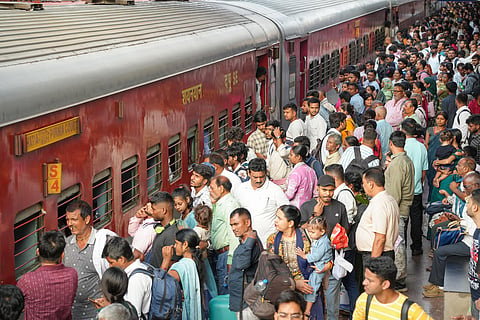

The Supreme Court on Friday directed the Centre to ensure there is no “complete prohibition” on metro and railway services to Delhi on October 10 amid security restrictions ahead of a protest called by the Cockroach Janta Party (CJP) and student organisations against Chief Election Commissioner Gyanesh Kumar.
A bench comprising Chief Justice of India (CJI) Surya Kant and Justices Joymalya Bagchi and V Mohana said security measures must be proportionate to the anticipated threat and should not cause undue hardship to ordinary citizens.
“The solicitor general has fairly agreed to impress upon the authorities to reconsider the prohibition and allow the movement of metro trains and other railway services in a suitably regulated manner,” the bench said, recording the assurance given by Solicitor General Tushar Mehta, who appeared for the Centre.
The court was hearing a plea challenging the closure of entry and exit gates at 57 Delhi Metro stations and the cancellation of trains scheduled to arrive in the capital ahead of Saturday’s protest.
“The only issue before us is whether the complete stoppage of metro trains and railway services from certain stations requires reconsideration,” the bench said, stressing that regulation and a complete prohibition were two different measures.
“One should not use a hammer to kill a fly,” the bench observed, adding that restrictions should go no further than necessary to address the anticipated security threat.
The court directed the Centre to publicise the authorities’ decisions on metro and railway services and ensure that inconvenience to the public was minimised. It also asked the authorities to review road closures and barricading and allow traffic to move freely wherever restrictions were not necessary.
“We are mainly concerned about the complete closure of these metro station entries. We have serious concerns about this,” the CJI told Mehta.
The bench said the restrictions could affect thousands of daily commuters travelling from Gurugram, Greater Noida and other parts of the National Capital Region to Delhi for work, education and other essential activities.
“Everybody does not have a car. Everybody does not have access to private transport. People depend on public transport. This cannot be done,” the CJI said.
“Citizens should not be unduly harassed. That is all we want,” he added, emphasising that law enforcement agencies must consider the needs of women, children, senior citizens and patients while maintaining public order.
Train cancellations flagged
Senior advocate Kapil Sibal, appearing for CPI(M) general secretary M A Baby, raised concerns over the cancellation of trains scheduled to arrive at New Delhi and Hazrat Nizamuddin railway stations during specified hours on Saturday.
He argued that the restrictions could prevent long-distance trains from reaching the capital even when their journeys originated far outside Delhi. Citing trains arriving from Kerala, Sibal said several were scheduled to reach the city between 11 am and 1.30 pm on Saturday.
The bench also questioned the apparent inconsistency between an advisory referring to reduced metro train frequency and a provision directing the closure of entry and exit gates at identified stations from 9 am on Saturday until the situation normalised.
Justice Bagchi said the complete closure of stations was difficult to reconcile with the proposal to regulate train frequency.
Mehta initially submitted that the advisory envisaged reducing the frequency of metro services at certain stations. He later assured the court that the government would consult the authorities concerned and review the restrictions in light of the evolving situation.
The CJI also highlighted the difficulties that court staff, clerks, canteen workers and other employees could face in reaching their workplaces, particularly those without access to private transport.
Centre cites previous protest
Defending the security arrangements, Mehta said organisers of an earlier protest had sought police permission on June 20 and were granted permission for a single day, from 10 am until around 4 or 5 pm.
The organisers had undertaken to vacate the protest site after the permitted period, but the demonstration continued for 17 days in alleged violation of the conditions, he said.
Mehta further alleged that protesters later attempted to march into a restricted area near Parliament, leaving more than 200 police personnel and some private individuals injured in the ensuing confrontation.
He said the government was responsible for protecting the right to protest as well as the safety and rights of the wider public.
On internet restrictions, the solicitor general submitted that the curbs were confined to areas around Rashtrapati Bhavan and Raisina Road, within an approximate four-kilometre radius, and were reviewed according to the prevailing situation.
He also offered to place video recordings of the earlier confrontation on record, alleging that women police personnel had been assaulted, injured and abused.
Allegations over police visits to mosques
During the hearing, a senior advocate alleged that Delhi Police personnel had visited mosques to discourage people from participating in Saturday’s demonstration. He said the allegations had been made on oath and referred to a photograph and video submitted to the court.
Mehta objected to the manner in which the issue was raised, describing it as an attempt at instigation rather than a genuine effort to seek justice.
The CJI declined to comment on the allegations without hearing the authorities concerned.
