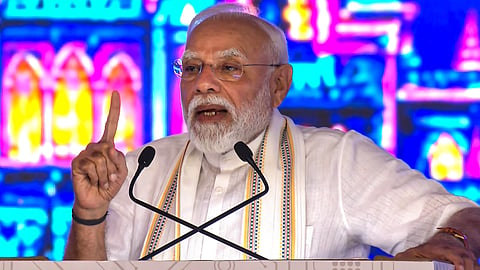

VADODARA: Prime Minister Narendra Modi on Tuesday mixed development politics with a sharp attack on the Opposition during his visit to Gujarat, using his Vadodara address to showcase infrastructure, manufacturing, railways, technology and youth-focused initiatives while repeatedly taking a swipe at what he described as the “Angry uncle” (Naraj Fufaji) mindset of his political rivals.
Modi was addressing a large gathering, mostly comprising youngsters, in Gujarat's Vadodara after inaugurating and laying the foundation stones of development projects worth Rs 35,000 crore.
Addressing the gathering, Modi recalled his political journey and said the people of Vadodara had sent him to Delhi at a crucial moment in the country's political transformation. Vadodara was the constituency from where Modi had contested the Lok Sabha election in 2014 alongside Varanasi.
Significantly, his Gujarat visit comes at a time when Vadodara MP Hemang Joshi has recently been appointed president of the BJP's National Youth Front, adding a fresh youth and political dimension to Modi's outreach to Gen-Z.
Aiming for the previous Congress-led regime, Modi said his government had transformed India's development pace after 2014.
“After 2014, India built 50,000 modern rail coaches. The previous (Congress) regime could not build even 50,000 toilets in 10 years,” he said.
He later repeated the comparison while taking a swipe at the Opposition, saying, “Now the Angry uncle (Naraj Fufaji) will always shout, but 50,000 modern rail coaches have been built since 2014. But the old government could not even build 50,000 toilets in 10 years.”
Modi said Vadodara was now emerging as a major symbol of India's manufacturing strength, adding that the city had earned national recognition for manufacturing the country's first Made-in-India aircraft. He further highlighted India's rapid expansion in the production of rail coaches, metro coaches and railway engines.
Turning to logistics and freight transport, Modi said the recently operated double-decker goods train from Jawaharlal Nehru Port to Vadodara had demonstrated the changing face of India's supply chain.
“Naraz Fufa will now scream: what will happen to truckers? Fufa has some work now,” Modi said, without naming Congress leader Rahul Gandhi.
Modi inaugurated three key sections of the Western Dedicated Freight Corridor, connecting Jawaharlal Nehru Port in Navi Mumbai with Dadri in Uttar Pradesh, marking completion of the project.
“Dedicated freight corridors are the lifeline of a fast-developing India. India’s transformation is accelerating because of this modern freight network,” Modi said.
Earlier, passenger and goods trains had to run on the same tracks, slowing down both passenger travel and freight movement but the Dedicated Freight Corridor has changed this, he said.
The Prime Minister said more than 430 goods trains were currently operating on the Eastern and Western Dedicated Freight Corridors. He claimed that freight trains which earlier covered 100 kilometres in nearly six-and-a-half hours could now complete the journey in almost half the time.
Similarly, he said, a journey that earlier took around 30 hours by truck could now be completed in 10 to 12 hours through the improved freight network.

“After 2014, with your blessings, when I reached Delhi, and as soon as we arrived there, we began accelerating this project. Work on the dedicated freight corridors has been completed today,” he said.
“Today, the Eastern and Western Freight Corridors are becoming the main backbone of the country's trade and business,” Modi said.
The 2,800-km long Dedicated Freight Corridor is a testament to how the country's work culture has transformed over the past 12 years, Modi said.
Recalling the delays before 2014, Modi said the Dedicated Freight Corridor project had remained stuck for years despite being conceptualised in 2004 and the concerned company being formed in 2006.
“The idea for this Dedicated Freight Corridor began in 2004. In 2006, a special company was established to carry out this work, and until 2014, files just kept shuffling from one place to another.
“Unfortunately, even these files weren't fortunate enough to get a dedicated corridor. Files would get stuck, hang around, wander aimlessly,” Modi said.
“In seven or eight years, even one kilometre of freight corridor work was not completed,” Modi said, adding that files had continued moving from one table to another until his government took office.
He said the government accelerated the project after 2014 and claimed that around 2,500 kilometres of work had now been completed.
Calling the freight corridor a “lifeline of Viksit Bharat”, Modi said the project was strengthening trade and giving a new direction to India's transportation ecosystem.
Highlighting Vadodara's strategic importance, he said the city was home to Gati Shakti Vishwavidyalaya and that the final links of the freight corridor had now been connected. He also referred to projects worth around Rs 2,800 crore being completed as part of the development push.
“This corridor is proof of how the country's working style has changed over the last 12 years,” Modi said.
The Prime Minister said his visit was aimed at giving further momentum to India's journey towards becoming a developed nation by 2047. He said projects worth thousands of crores were inaugurated and foundation stones laid during the visit.
Modi also praised Vadodara's cleanliness initiatives and congratulated residents for their participation in the Swachhata campaign. Switching to Gujarati, he appealed to citizens to take a pledge not to litter the city and to keep Vadodara clean, particularly during the festive season.
Sharpening his political attack, Modi also took a swipe at Congress leader Rahul Gandhi's 'Chhatron Ki Goonj' initiative, saying youngsters would stand with the truth and not be misled by what he termed "Jooth ki Goonj" (echo of lies).
"At every nook and corner, you will find people who will try to mislead you through 'Jooth Ki Goonj', but today's youth will stand with the truth," Modi said.
'Chhatron Ki Goonj' is a student-dialogue campaign launched by the Congress, under which programmes are being organised in various cities across the country.
Through the campaign, the Opposition party is attempting to corner the ruling BJP on issues such as exam question paper leaks, costly education, irregularities in government recruitment and unemployment.
Modi said those spreading “lies” could be found everywhere, but asserted that India's youth were moving forward with the “roar of truth”.
He then linked the country's future to electricity, clean energy and a stronger technology ecosystem, saying India would have to strengthen its capabilities for the next generation.
Modi also focused heavily on Gen-Z and young Indians, arguing that education was moving beyond degrees and increasingly towards skills. He said the government was working to provide free online coaching for competitive examinations and was preparing a new campaign to help young Indians develop expertise in Artificial Intelligence.
“India's youth must become proficient in AI,” Modi said, adding that the technology would create opportunities across multiple sectors.
He said the government's larger objective was to prepare the youth to play a central role in building a developed India by 2047.
The Prime Minister also highlighted the expansion of railway infrastructure, saying new train services would benefit people in Vadodara, Chhota Udepur and Alirajpur. He said the railway budget had crossed Rs 3.5 lakh crore and was several times larger than previous allocations.
According to Modi, infrastructure development was not limited to connectivity, as new roads, railways and logistics networks also attracted industries and generated employment opportunities.
On the clean-energy front, Modi said India was moving towards building a complete domestic chain of self-reliance. Referring to the solar plant project at Kadana Dam, he said solar projects had once been prohibitively expensive but domestic manufacturing of photovoltaic modules had changed the situation.
He said India had developed significant solar module manufacturing capacity and added that around 11 lakh families in Gujarat had already benefited from the PM Solar Yojana.
From freight corridors and rail coaches to AI, solar power and youth employment, Modi's Vadodara speech carried a clear political message, with the BJP seeking to frame the post-2014 period as an era of accelerated development, while positioning Gen-Z and young Indians as the central force behind its Viksit Bharat vision.