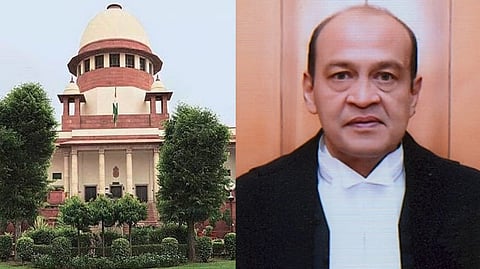

NEW DELHI: The Supreme Court is scheduled to hear on Monday, July 28, the appeal filed by Justice Yashwant Varma, challenging the in-house committee probe report that indicted him over the recovery of a huge sum of unaccounted cash at his official residence in Delhi.
According to the causelist uploaded on the apex court’s website, a two-judge Bench comprising Justice Dipankar Datta and Justice Augustine George Masih will hear Justice Varma’s appeal.
The hearing assumes great significance, considering the fact that the impeachment process have already been initiated in Parliament for his alleged misconduct in connection with the recovery of cash.
On July 17, Justice Varma filed an appeal before the top court challenging the in-house committee report that found him guilty of misconduct. He contended that the mere recovery of cash from the outhouse of his official residence did not establish his culpability.
Subsequently, on July 23, he mentioned the matter before a Bench led by Chief Justice of India (CJI) B.R. Gavai, seeking an early hearing. The Supreme Court agreed to list the matter.
Senior advocate Kapil Sibal, appearing for Justice Varma, submitted before the CJI-led three-judge Bench that the matter involved important constitutional questions. The CJI assured him that an appropriate Bench would be constituted to hear the matter but recused himself, citing his prior involvement in internal discussions related to the case. “I think it will not be proper for me to take up that matter because I was a part of that conversation,” the CJI said.
In his writ petition, Justice Varma contended that the in-house inquiry committee had failed to ascertain the ownership of the cash or how it came to be recovered from the premises. “Mere discovery is not sufficient to link him to any wrongdoing, without any clear evidence regarding its ownership and control,” he submitted.
Justice Varma's decision to move the apex court marks a significant and unprecedented development, as it is arguably the first instance of a sitting High Court judge challenging an in-house inquiry report before the Supreme Court.
The petition also challenges the recommendation made by former CJI Sanjiv Khanna to initiate impeachment proceedings against him.
Justice Varma alleged that the committee did not provide him a fair opportunity to respond and proceeded in a "pre-determined" manner, drawing adverse inferences without concrete evidence and effectively reversing the burden of proof.
He further argued that the committee's mandate as a fact-finding body was unjustifiably curtailed. “The mere discovery of cash provides no conclusive resolution. It remains essential to determine whose cash was found and in what quantity,” he added.
Justice Varma also questioned the constitutional validity of the in-house procedure, arguing that it lacked statutory backing and violated the doctrine of separation of powers.
He contended that the judiciary cannot assume a role reserved for the legislature in recommending the removal of judges.
“The Constitution confers no disciplinary powers on this Court or the Chief Justice of India over High Courts or their judges. Administrative or self-regulatory procedures such as the in-house mechanism cannot override the constitutionally protected tenure of High Court judges,” he stated.
He maintained that the in-house procedure permits recommendations that amount to punitive outcomes without legislative sanction, which oversteps constitutional boundaries and undermines judicial independence and public confidence.
Justice Varma claimed that the committee had adopted a hasty procedure to achieve a pre-determined outcome and had not provided him adequate opportunity to present his case.
He raised several unanswered questions: when and how was the cash placed in the outhouse, who placed it, how much was placed, whether the currency was genuine, and the cause of the fire reported at the premises.
“The final report dated May 3 provides no answers to these pivotal questions,” he contended.
Challenging the procedural fairness, Justice Varma said the committee had failed to notify him of its procedural framework, denied him the opportunity to contribute to the collection of evidence, examined witnesses in his absence, provided only paraphrased statements instead of video recordings, selectively disclosed only incriminating material, and disregarded exculpatory evidence, including CCTV footage, despite his repeated requests.
“The committee denied me a personal hearing, contrary to established precedents,” he said.
