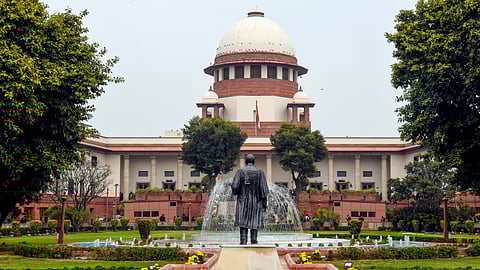

NEW DELHI: In a landmark ruling, the Supreme Court on Friday directed that investigating officers must not summon lawyers representing the accused, except under specific exceptions provided in law, and any such summons must clearly cite those exceptions.
A three-judge bench comprising Chief Justice B R Gavai and Justices K Vinod Chandran and N V Anjaria said that issuing summons to advocates could infringe upon the fundamental rights of the accused and violate statutory protections of lawyer-client confidentiality. The order came while setting aside a summons issued in a related case.
The court emphasised that investigators cannot seek details of a client from an advocate unless it falls within the exceptions listed under Section 132 of the Bharatiya Sakshya Adhiniyam (BSA), which protects confidential communications between lawyers and clients.
On the handling of digital devices, the bench clarified that under Section 94 of the Bharatiya Nagarika Suraksha Sanhita (BNSS), such devices can be produced only before the jurisdictional court, which must issue notice to the concerned party. The device can be opened only in the presence of the party, their advocate, and digital experts of their choice.
The Supreme Court pronounced its order in a suo motu cognisance (SMC) examining whether probe agencies can summon advocates who render legal opinions or represent clients during investigations.
The SMC power, derived from Articles 32 and 226, which relate to the enforcement of fundamental rights, and Article 142, which grants the Supreme Court wide discretionary powers, allows the court to act on its own without a formal petition or complaint.
The Supreme Court on Friday directed that investigating agencies, when seeking information from advocates in exceptional cases, must ensure that the confidentiality of their other clients remains protected and limit their inquiry strictly to what is required by the prosecuting officer.
The bench pronounced the order, which had been reserved on August 12 after detailed hearings from Solicitor General Tushar Mehta, who represented the Enforcement Directorate (ED) and other parties.
The suo motu proceedings were initiated on July 8 after the court took note of the ED summoning senior lawyers Arvind Datar and Pratap Venugopal for providing legal opinions or representing clients during investigations.
However, after a lot of hue and cry by the legal fraternity, the ED withdrew its summons to these two lawyers. The court had observed then that it acted as the custodian of citizens’ rights.
During the hearings, Mehta stressed that lawyers are integral to the administration of justice and deserve protection in that role. He urged the court to establish clear guidelines balancing investigative needs with legal safeguards, remarking that “a lawyer should never be called by investigating agencies merely for providing professional advice.”
The court also clarified that this protection is not absolute if a lawyer deviates from professional duties to advise on tampering fabricating evidence, such immunity would not apply. "We cannot create two classes of lawyers," the bench remarked, while noting the need for a uniform legal set of principles in this regard.
Senior advocate and former Additional Solicitor General (ASG) Vikas Singh, appearing for the Supreme Court Bar Association (SCBA), and advocate Vipin Nair for the Supreme Court Advocates-on-Record Association (SCAoRA), opposed the ED’s move to summon lawyers, warning that such actions could have a chilling effect on the legal profession. “If lawyers can be routinely summoned for advising clients, no one will dare provide counsel in sensitive criminal cases,” Singh cautioned.
Singh emphasised that adequate safeguards, similar to those followed by the CBI, should be implemented to prevent misuse of summons. He suggested that any summoning order should come from the Superintendent of Police of a district and be scrutinised by a judicial magistrate before issuance.
Echoing on similar voices with Singh, Nair expressed deep concern over the issuance of summons under Section 50 of the Prevention of Money Laundering Act, 2002, highlighting that such actions constitute an impermissible transgression of the sacrosanct principle of lawyer-client privilege. "This pose a serious threat to the autonomy, independence, and fearless functioning of the Bar," Nair stated.
SCAORA urged the court to examine the legality of such actions and establish clear guidelines to safeguard the constitutional and professional protections guaranteed to advocates.
On the other hand, Mehta, agreed with the court's saying that lawyers should not be summoned merely for offering legal advice.
"The privilege of communication between a lawyer and a client must be respected. The profession itself is protected under the proviso,” Mehta had pointed out.
Earlier, during the July 21 hearing in the suo motu case, the apex court had expressed strong concern over the Enforcement Directorate’s practice of summoning advocates who offer legal opinions or represent clients during investigations, observing that the agency was “crossing all limits.” The court had then said it would issue comprehensive guidelines to prevent such overreach.
Nair had also earlier written to the CJI Gavai on the "deeply disquieting development" having "serious ramifications for the independence of the legal profession and the foundational principle of lawyer-client confidentiality".
After the unfortunate incident, Venugopal, talking to the TNIE, said, the ED action of summoning to him was completely illegal, unconstitutional, unwarranted.
"It is sad and unforunate. The action of issuing summons to Advocates is an alarming practice and besides being wholly contrary to the provisions of Sec 132 of the Bharatiya Sakshya Adhiniyam (BSA) 2023 seeks to intimidate Advocates from advising clients and further identifies Advocates with their clients which contrary to well established principles," Venugopal said.
SCAORA said that Venugopal is “a widely respected member of the legal fraternity,” whose professional record and sincerity led to his designation as a Senior Advocate earlier this year.
“These actions, by the ED, we believe, amount to an impermissible transgression of the sacrosanct lawyer-client privilege,” the letter continues, warning that such coercive measures could have a chilling effect on the legal community," the SCAORA had said.
Requesting the Supreme Court to act decisively, the Association urged the Court to examine the legality and propriety of such summonses to legal professionals. "Safeguard the constitutional and professional protections afforded to advocates. Lay down guidelines to prevent further erosion of lawyer-client privilege," it said.
The SCAORA had further opined that the role of an advocate, in offering legal advice, is both privileged and protected. Interference by investigative agencies strikes at the heart of the rule of law.
