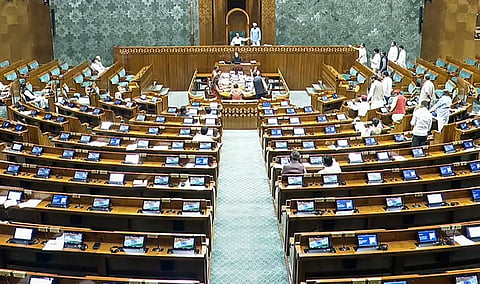
The Lok Sabha witnessed another day of high-stakes showdown on the second day of the special session, with the women’s reservation and delimitation bills failing to secure a two-thirds majority in the Lok Sabha.
While 298 members voted in favour of the Bill, 230 members voted against it. No members abstained from voting.
Notably, the NDA lacks the numbers in Parliament to pass the women’s reservation bills with the required two-thirds majority. The NDA currently has the backing of 293 Lok Sabha members, accounting for 54% of the House, while the opposition holds 233 MPs.
The rules require 360 MPs to support the bills, including the Constitution amendment bill, which comes to two-thirds of those present and voting.
Notably, the Centre on Thursday introduced three bills in the Lok Sabha to amend the women’s quota law and set up a delimitation commission, which a united Opposition has decided to vote against, terming them an “attack on the Indian federal structure.”
Speaking today in the Lok Sabha debate, LoP Rahul Gandhi targeted Prime Minister Narendra Modi, calling the proposed bills a "panic reaction" to change the country’s electoral map and that the "magician has been caught."
A day earlier PM Modi told the Lok Sabha that no state will be discriminated against in the delimitation of constituencies, even as the opposition claimed democracy will be finished in India if the Constitution amendment bill is passed.
He also warned the opposition it would "pay a price for a long time" for opposing the three bills.
After the deafet of the Constitution amendment bill, Union Parliamentary Affairs Minister Kiren Rijiju said the Opposition lost a historic opportunity to honour women.
He also said the Narendra Modi-led government's struggle to give rights to women will continue. He added the government will make sure that women get reservation in legislatures.
The women's reservation failed to secure a two-thirds majority in the Lok Sabha voting on Friday.
While 298 members voted in favour of the Constitution (131st Amendment) Amendment Bill, 230 members voted against it. No members abstained from voting.
The rules require 360 MPs to support the bills, including the Constitution amendment bill, which comes to two-thirds of those present and voting.
The NDA currently has the backing of 293 Lok Sabha members, accounting for 54 per cent of the House, while the opposition holds 233 MPs.
Lok Sabha Speaker Om Birla said, "The Constitution (131st Amendment) Amendment Bill did not pass as it did not achieve a two-thirds majority during voting in the House."
The Government said it will not move ahead with the Delimitation Bill and another Bill to amend the women's quota in union territories after the defeat of the Constitution Amendment Bill.
Constitution (131st Amendment) Amendment Bill gets 278 ayes and 211 noes; 489 voted in Lok Sabha pic.twitter.com/eMdZ4LKTyo
— ANI (@ANI) April 17, 2026
Amit Shah on Friday said the Women's Quota Amendment Bill will fall flat if the Opposition does not vote in its favour, but women are watching who the obstacle is.
"The women of the country are watching who is creating a hurdle in their way," he said.
"Nearly 133 Members spoke in the House on this important constitution Amendment Bill, out of which 56 Members were women, which will prove to be a record in itself..." he said.
Amit Shah also vowed to implement the reservation. "We will fight and deliver on our promise to provide reservations to women."
He also assured of an official amendment mentioning 50 percent increase in Lok Sabha seats across states if the opposition agrees.
Amit Shah trashed claims that the bill to amend the women's quota law was aimed at delaying caste enumeration during the census.
"To make sure that there is no confusion in the minds of 140 crore Indians, I want to make it clear that the Narendra Modi Cabinet had decided to hold caste census along with 2026 census."
He also said the Congress party has historically opposed caste-based census and reservation.
"In 1980, former PM Indira Gandhi put the Mandal Commission on hold. In 1990, when Rajiv Gandhi became the PM, it was accepted, and he gave a two-and-a-half-hour speech and opposed OBC reservation," Shah said.
He further said the Congress party, in all these years, never had an OBC Prime Minister. “This changed after Narendra Modi became the PM,” Shah added.
Amit Shah said Congress deprived people of delimitation when it was in power. “It is still doing the same,” he added.
"In 1972, the then PM Indira Gandhi's government brought the Delimitation Bill and increased the number of seats from 525 to 545, and then froze it at this. In 1976, to save power during the Emergency period, the 42nd Amendment imposed a ban on delimitation.
Even at that time, it was the Congress party that deprived the country's people of delimitation, and today too, it is the Congress party that is depriving them of delimitation."
#WATCH | Delhi: Speaking in Lok Sabh on the Women's Reservation Bill and the Delimitation Bill, Union Home Minister Amit Shah says, "Nearly 133 Members spoke in the House on this important constitution Amendment Bill, out of which 56 Members were women, which will prove to be a… pic.twitter.com/N6pfsIonXY
— ANI (@ANI) April 17, 2026
Union Home Minister Amit Shah alleged that the Opposition was spreading misinformation that the Northern states would get more representation if the Delimitation bill was passed.
“I want to make it clear that South representation will not come down post delimitation, I can guarantee that,” he said.
MPs from southern India have the same rights as the members from the northern parts of the country, he said. “Even people from a small UT like Lakshadweep should be fairly represented,” he added.
"The country should not be divided by this ‘north-south’ 'east-west' narrative. We should rise above it. All states and UTs have equal rights in this parliament," said Amit Shah as he targeted the Opposition.
In a reply to the debate on the Women's Reservation Bill and the Delimitation Bill in the Lok Sabha, Union Home Minister Amit Shah said, "No one has objected to the women's reservation. But, if we see closely, all members of the INDI alliance have opposed it by using 'ifs and buts' ".
He added that the Opposition is not against the implementation of quota law but against women's reservation.
"Those opposing delimitation are actually opposing an increase in SC/ST seats," he further said.
The Home Minister said that delimitation will lead to the rationalisation of voters in every constituency. “Every voter should have an equal value for their right, and post this expansion, we believe, they will,” he said.
Union Minister Annpurna Devi said the proposed amendment to the Women's Reservation Act reflects the aspirations of crores of women and will mark a historic step towards ensuring their greater participation in lawmaking.
The minister for women and child development said the bills are strong proof of women's rights and dignity in India.
"Crores of women across the country are watching the proceedings with great hope and expectation.
After decades of struggle, they feel their aspirations are finally being fulfilled," Devi said.
Claiming that such efforts faced repeated delays earlier, she said, "Whenever it comes to giving rights to women, the opposition creates hurdles to delay and derail the process."
She also questioned the Congress' record on OBC issues, saying the party failed to act on key measures despite being in power for decades.
DMK MP A Raja on Friday accused the Bharatiya Janata Party-led Centre of trying to promote discrimination, the north-south divide and "one nation, one language, one culture" in the name of women's rights.
Speaking in the Lok Sabha, Raja alleged that the government as well as the prime minister and the home minister are trying to undermine Parliament.
He also he warned that the proposed delimitation exercise could upset India’s federal balance, citing BR Ambedkar to say the south’s "hatred will grow" if the north exercised disproportionate influence.
VIDEO | Parliament Session: "Ambedkar wrote 'south's hatred will grow, if north continues to exercise disproportionate influence'; ratio of number of seats and population must be same as per Constitution," says DMK MP A Raja in Lok Sabha.#WomensReservationBill… pic.twitter.com/XsArt0nkQL
— Press Trust of India (@PTI_News) April 17, 2026
Raja said the principle of representation must remain aligned with population in a manner consistent with the Constitution, and flagged concerns over potential imbalances between regions.
He argued that states which had effectively implemented population control policies should not be disadvantaged, warning that rewarding higher population growth with greater political weight would send the wrong signal.
The DMK MP said the move risked weakening the voice of southern states and asserted that any attempt to reduce their representation in Parliament would be strongly opposed.
Union minister and JD(S) leader H D Kumaraswamy on Friday described the DMK's arguments against bills to tweak the women-quota law as "fear mongering" and said they do not represent the views of the southern states.
The DMK, which is in power in Tamil Nadu, has been vehemently opposing the bills and have raised concerns that they would adversely impact the southern states.
During a discussion on the bills in the Lok Sabha, Kumaraswamy, who has been the chief minister of Karnataka twice, said the Congress is not prepared to handle the massive change and that the party has lost touch with people and does not know how to cope with this transformation.
Terming the DMK's arguments "fear mongering", the heavy industries minister said those represent the party's own views and not that of the southern states.
"The Congress, which has lost the capacity to think independently, lost its ability to develop its own arguments is now being led by the DMK's narrative," he alleged, adding that the Opposition under the Congress has got into the habit of scaring people and creating a doomsday scenario about everything the government says.
Voting on the delimitation and women’s reservation amendment bills in the Lok Sabha has been postponed to 7 pm, from the earlier scheduled time of 4 pm.
Union Home Minister Amit Shah will respond to the debate on the Women's Reservation Bill and the Delimitation Bill in the Lok Sabha around 6 pm.
When asked about the “April 16” puzzle he mentioned in his Lok Sabha speech, Leader of Opposition and Congress MP Rahul Gandhi said, “It’s a puzzle. I won’t tell the answer this way.”
This comes after Rahul, while speaking in the Lok Sabha debate, said: "Yesterday I was watching the Prime Minister speak. Low energy, broken, nothing transmitting, and I suddenly noticed that yesterday was the 16th of April... He was not able to engage because clearly trying to pass this bill was a mistake because everybody knew there was gonna be a past panic reaction, as I said. So I was watching him and I noticed on my phone, 16th of April. And I was like, my God, how crazy. That's the number, 16. This 16 number, this is the number. The whole answer to the riddle is in the number 16. Everything is in the number 16."
BJP MP Hema Malini on Friday said the women's quota bill will usher in a new era which will ensure equality and empowerment of women.
Participating in a discussion in the Lok Sabha on the amendment to the women's quota law of 2023, the actor-politician also said that there is a need to change the "thinking" of the society along with the law to ensure that women get respect in families and society.
"The bill is an honour to the struggle, courage and strength of women. It would ensure that women can become partners in decision-making and realise their dreams. The bill will usher in a new era of respect, equality and empowerment," said the BJP MP from Mathura in Uttar Pradesh.
She said that the bill does not "discriminate" based on caste or religion, and will increase women's representation to 33 per cent in the Lok Sabha and state assemblies from the existing 15 per cent and 10 per cent respectively.
"Women have been empowering their families and communities without any sense of identity. This women's quota bill provides them an opportunity... This step is meant to give courage and confidence to the daughters of future generations to become partners in decision-making," Hema Malini said.
Union Minister Rajiv Ranjan Singh on Friday hit out at the opposition saying the proposed amendment to the women quota law is not a decision taken in haste but based on sound homework. Singh, who is the Panchayati Raj Minister, is a MP from JDU -- a key ally in the ruling NDA.
Intervening in the discussion in Lok Sabha on the amendment to the women quota law of 2023, he said the opposition's claim that the amendment bill is a decision taken in haste is baseless. He said the government took three years to bring an amendment after a thorough ground work.
"The first historic step towards ensuring equal participation of women in lawmaking was taken in 2023 when the Nari Shakti Vandan Adhiniyam was passed in September and the second step is being taken now. This is not a decision taken in haste but based on sound and thorough groundwork done over a period of three years," he said.
Singh said Prime Minister Narendra Modi has cautioned the opposition that if they do not support the bill, they have to pay a price for a very long time The Constitution (131st Amendment) Bill to tweak the women's quota law was introduced in the Lok Sabha on Thursday after a division of votes.
Leader of Opposition Rahul Gandhi on Friday targeted Prime Minister Narendra Modi, calling the women’s bill a "panic reaction" and saying the "magician has been caught".
"The BJP knew, they knew very clearly that this bill actually cannot be passed. They knew it. They're not stupid. They knew every opposition person would oppose it. This bill cannot be passed. This was a panic reaction because the Prime Minister, at any cost, needed to send two messages. Number one, he needed to change the electoral map of India. And number two, he needed to send a message again that he is pro-women. Why he is doing that, I will leave to your imagination," he said.
"The truth is the magician has been caught. The magician of Balakot, the magician of demonetisation, the magician of Sindoor has suddenly got caught," Rahul added.
Leader of Opposition Rahul Gandhi on Friday accused the government of signalling to southern, northeastern and smaller states that their representation would be reduced to keep the BJP in power.
Gandhi termed the move “nothing short of an anti-national act” and said the Opposition would unite to defeat it in Parliament. He also sought to reassure southern, northeastern and smaller states, saying the Opposition would not allow any dilution of their representation in the Union.
Leader of Opposition Rahul Gandhi on Friday accused the BJP of being "scared of erosion" of its political strength and said the government was attempting to "rejig" India’s political map through the proposed changes.
Speaking in the Lok Sabha, Gandhi urged the government to bring back the 2023 women’s reservation bill for immediate implementation, saying the Opposition would support its passage "this second."
He also alleged that the government was seeking to avoid giving adequate power and representation to OBCs, and was attempting to ensure that a caste census had no bearing on political representation for the next 15 years.
"It is a historical fact that how Indian society treated Dalits and OBCs and their women... What is being attempted here is a bypass of the caste census. Here, they are trying to avoid giving power and representation to my OBC brothers and sisters and taking power from them," Rahul said.
"Amit Shah ji says that the caste census has begun. He repeated twice, trying to be clever, saying that houses don't have caste. The point is whether or not the caste census is going to be used in representation in Parliament and state assemblies. And now, what you are trying to do is that caste census has nothing to do with representation for the next 15 years," he added.
Addressing the Lok Sabha debate on the women’s quota bill, Leader of Opposition Rahul Gandhi asserted that the legislation had little to do with advancing women’s empowerment and called it an attempt to change country's electoral map using and hiding behind India's women.
"Some truths need to be told here. This is not a women's bill; this has nothing to do with empowerment of women. This is an attempt to change the electoral map," Rahul said.
Congress MP and Leader of Opposition in the Lok Sabha, Rahul Gandhi, speaks in the debate on delimitation and women's reservation bills in the Lower House. Rahul hails women as a driving force in our national perspective.
Congress MP Kumari Selja on Friday said that while every other party has clearly elaborated their stance on Women's Reservation and the specific objections they have with its process of implementation, it is the Bharatiya Janata Party (BJP) which has not shown clear intent on it.
She said that the government could have implemented the reservation with the existing 543 seats with the original 2023 law itself, but they did not even notify it till now.
"Everyone has made their stance clear. Every party in Opposition has explained how they are opposing it and why we are doing so. The BJP's position is not at all clear. You had bought in the reservation (with the passing of 2023 bill), but you did. You haven't even started the process to implement reservations for the previous law until now. You could have implemented with the current 543 seats. You didn't even notify the previous law that was enacted. Now they stand exposed," Selja said.
#WATCH | "Our people are fighting and will defeat it in Lok Sabha," says LoP Rajya Sabha and Congress President Mallikarjun Kharge, on new Delimitation Bill. pic.twitter.com/k8sUsgiiuI
— ANI (@ANI) April 17, 2026
Samajwadi Party MP Dimple Yadav on Friday accused the government of misrepresenting the Opposition’s stand on the women’s reservation law, highlighting that the parties had supported the bill's passage in 2023.
Speaking during the Lok Sabha debate, Yadav said the government lacked genuine commitment to women’s empowerment and that it had introduced the bill as its "vote share is slipping."
She questioned why the Census had not been conducted over the last two-and-a-half years, alleging that the government was showing "so much haste" and aimed only to "weaponise the delimitation" exercise.
"If the government truly wanted women’s empowerment, the Census would have been conducted by now and women would already have got their rights... You have brought this amendment because you see your vote share slipping," Yadav said and further demand equal representation for women from SC, ST, OBC and minorities communities.
As Parliament began debate on amendments to the women’s reservation Act and the delimitation bill, INDIA bloc leaders on Friday coordinated attendance in the Lok Sabha, sources said.
Congress leaders KC Venugopal, Manickam Tagore and P Chidambaram, along with TMC leader Kakoli Ghosh Dastidar, were ensuring the presence of INDIA bloc MPs in the House ahead of the vote, the sources said.
Earlier in the day, INDIA bloc MPs held a meeting in Parliament at Congress president Mallikarjun Kharge’s chamber to chalk out their floor strategy.
According to the list of business, the Lok Sabha is scheduled to vote on the constitutional amendments and the Delimitation Bill, 2026, with the vote expected around 4 pm.
The Congress has also issued a three-line whip to its Lok Sabha MPs to remain present during the special sitting from April 16 to 18 and support the party’s position. Kharge had earlier said on Wednesday that opposition parties had decided to vote against the proposed constitutional amendment bill on delimitation.
Congress on Friday accused the Centre of misleading the House on the women’s reservation bill and opposed its linkage with the proposed delimitation bill, demanding an all-party meeting before voting.
Congress MP Mallu Ravi alleged the prime minister had made "misleading statements" in the House, saying the Congress was committed to the bill but objected to its linkage with delimitation. He also said the government had refused an all-party meeting ahead of the vote.
Congress MP Ujjwal Raman Singh questioned the government’s intent, citing remarks by Priyanka Gandhi Vadra that the Centre could take credit but should still implement 33% reservation within the existing 543 seats.
Congress MP Imran Masood called for a caste census before proceeding, saying the proposal to increase seats required detailed discussion and could not be rushed.
TMC MP Kalyan Banerjee on Friday opposed the three bills, calling delimitation a "political gimmick" brought for "bargaining".
Speaking in the Lok Sabha debate, Banerjee criticised the the BJP while invoking religious references, saying, "We are Kali, Durga bhakt. You are only Jai Shri Ram. You don’t even take Sita’s name. We say Jai Siya Ram."
"We oppose the linking (women’s reservation) with delimitation… why have you brought this for bargaining?," he asked.
Banerjee further questioned the government asking why it had not reserved 50% of ministerial posts for women, and quipped that even the posts of Prime Minister and Lok Sabha Speaker could be rotated and be reserved for women.
Congress MP Shashi Tharoor on Friday criticised the proposed delimitation exercise, warning it could amount to "political demonetisation" and calling for wider deliberations.
Speaking in the Lok Sabha debate, Tharoor said Prime Minister Narendra Modi "has brought ‘Nari Shakti’, wrapped it in barbed wire," questioning the intent behind the women’s reservation move.
"Today, we stand at a threshold where there is remarkably a near unanimous political consensus in favour of women's reservation. Every major party in this house recognises that the time for tokenism is over and the era of equal partnership must begin. And yet I'm finding myself deeply perturbed by the legislative exercise before us," Tharoor said.
"The Prime Minister says the government has brought 'Nari Shakti', a gift of justice, but he has wrapped it in barbed wire, tethering the implementation of women's reservation to the expansion of Parliament, to numbers from the 2011 census, and an exercise of delimitation," he added.
Tharoor also outlined key fault lines in the exercise, citing imbalances between larger and smaller states, and between southern states such as Tamil Nadu and Kerala that have met population control goals and northern states that have not. He said delimitation could reward states with higher population growth with greater political weight, raising questions over the message it sends.
The Congress MP also flagged concerns over disparities between economically stronger states and those more reliant on central funds.
Tharoor also pointed to the European Parliament's model of degressive proportionality which prevents the domination of smaller, less populous units by larger ones as a possible approach to strike a balance.
DMK MP Kanimozhi Karunanidhi on Thursday criticised the move to amend the women’s quota bill alongside the delimitation bill, saying women in Tamil Nadu, with high literacy levels, would not allow their rights to be "hijacked."
Speaking on the Debate in Lok Sabha, Kanimozhi warned that linking women’s reservation to delimitation would reduce the collective bargaining power of southern states, calling the move a "trap" and accusing the BJP of using women as a "human shield".
She urged the government to implement reservations within the existing 543 Lok Sabha seats, saying women in the country had long been"starved for political power."
The DMK MP also questioned the timing of the government’s move to notify the Women’s Reservation Act, 2023, asking what purpose the debate served if the law had already been brought into force.
Kanimozhi further questioned the urgency of the move, calling it an "electoral escape", and raised concerns over the proposed delimitation process, saying the commission would be appointed by the government without adequate consultation or parliamentary oversight. She asked what recourse would be available if its recommendations were contested.
Notably, DMK MPs continued to wear black for a second day in protest against the legislations introduced in the Parliament.
Proceedings in the Lok Sabha began on a stormy note, with Congress MP KC Venugopal questioning the late-night notification of the Women’s Reservation Act, 2023, coming into force.
Venugopal asked "how can the minister move amendments to the Bill", without notifying the Act, as other MPs joined the chorus seeking a response from Law Minister Arjun Ram Meghwal.
Notably, the Union Government late of Thursday notified that the Women’s Reservation Act, 2023, came into effect from April 16, even as Parliament debates changes to enable its implementation from 2029.
The Women’s Reservation Act, 2023 (Nari Shakti Vandan Adhiniyam), which provides a 33% reservation for women in the Parliament and state legislatures, came into force on Thursday, ahead of Friday's 4pm vote in the Lok Sabha which is discussing on the amendments to operationalise it.
The law was notified with effect from April 16, even as Parliament debates changes to enable its implementation from 2029.
An official explained that bringing the law into force was essential, as its proposed amendment will not have come into effect without that.
The constitution amendment Bill became a law but did not become part of the Constitution as the government did not bring it into force. If a law does not come into force, how can its proposed amendment be implemented. Hence it was brought into force with effect from April 16, the official explained.
Harivansh elected Deputy Chairman of Rajya Sabha for a third term. The journalist-turned-politician, a nominated member of the House, was elected unopposed.
The Office of the Deputy Chairman, Rajya Sabha, fell vacant after the term of Harivansh ended on April 9. Union minister and Leader of the House JP Nadda moved the first motion for electing Harivansh as the Deputy Chairman of the Rajya Sabha.
Speaking on the floor of the Upper House, Prime Minister Narendra Modi congratulated Harivansh on being re-elected Deputy Chairman of Rajya Sabha. "Being elected as Deputy Chairman for the third consecutive term is a testament to the deep trust this House has in you, the benefits the House has received from your experience over the past period, and your efforts to take everyone along," he said.
"We have all seen the strength of the House grow even more effective under Harivansh's leadership. Not only does he conduct the proceedings of the House, but he also uses his past experiences to enrich the House with great precision," Modi said.
"I am confident that the Deputy Chairman's new term will proceed with the same spirit, balance, and dedication. Through the efforts of all of us, the dignity of the House will reach new heights," he added.
Tamil Nadu Chief Minister MK Stalin on Friday urged the Centre to withdraw the proposed Constitutional Amendment Bill and retain the current number of Lok Sabha seats for another 25 years, in line with the safeguards provided by the governments under Indira Gandhi and Atal Bihari Vajpayee.
"This Bill must not be rushed through in haste. The Union Government must withdraw it in full. If they attempt to bulldoze it through Parliament, emboldened by the numbers they have stitched together, and in complete disregard of our opposition, they will face the consequences in Tamil Nadu," Stalin wrote on X.
"What we demand is clear. The same constitutional safeguard that former Prime Ministers Indira Gandhi and Atal Bihari Vajpayee provided by freezing delimitation through constitutional amendment must be restored", he added.
தொகுதி மறுவரையறைச் சட்டத் திருத்தத்தை ஒன்றிய பா.ஜ.க. அரசு மொத்தமாகத் திரும்பப் பெற வேண்டும்!
— M.K.Stalin - தமிழ்நாட்டை தலைகுனிய விடமாட்டேன் (@mkstalin) April 17, 2026
தமிழ்நாட்டின் அரசியலுக்கு மிக முக்கியமான நாள் இன்று. தொகுதி மறுவரையறைக்கு எதிரான நம் போராட்டங்களின் முடிவினை அறியப் போகும் நாள்.
நம்முடைய கடும் எதிர்ப்பினையும் போராட்டத்தினையும்… https://t.co/MxXNNgZwNH pic.twitter.com/uvSHcMhe1U
On Thursday, a heated exchange erupted in the Lok Sabha between BJP’s Tejasvi Surya and DMK’s A Raja during debate, with Surya accusing the DMK of “separatism” and backing a united India from Kashmir to Kanyakumari. Raja rejected the charge, saying the DMK stands firmly for nationalism and citing Tamil Nadu’s contributions during the 1971 war and the Kargil conflict.
Surya also drew criticism for linking Telangana’s statehood agitation with the Partition of India, with BRS leader K T Rama Rao calling the remarks “utterly foolish” and “arrogant” and accusing the BJP of showing “hatred” towards Telangana’s formation in Parliament.
As India turns its attention to the question of women’s representation, it is imperative to recall the diminutive yet powerful figure who first made the demand politically inescapable: CPI's Geeta Mukherjee, fondly called ‘Geetadi’.
At a moment when the idea is finally moving from legislative promise towards implementation, remembering her is not merely an act of tribute— it is essential to understanding the long and unfinished history of the demand. She belonged to a political tradition in which ideas were shaped beyond immediate electoral arithmetic.
Long before women’s reservation entered mainstream political discourse, she recognised that the marginal presence of women in legislatures was not incidental but embedded in patriarchy.
Lok Sabha math: NDA Holds 293 MPs (54%) in Lok Sabha, well short of the 360 members needed for a two-thirds majority. BJP leads NDA with 240 MPs, followed by TDP (16) and JDU (12). Opposition has 233 MPs, with Congress leading the INDIA bloc with 98 MPs. An additional 14 MPs (independents + other parties like YSRCP, Shiromani Akali Dal, AIMIM) yet to declare support.
Key hurdle: Bills require backing from opposition or abstentions to pass. Abstention or support from opposition parties like SP (37), TMC (28), or DMK (22) could be decisive.
Rajya Sabha math: NDA has 141 MPs (58%) and opposition has 83 MPs. NDA needs 163 for two-thirds majority. BJP has 107 MPs, Congress has 28, TMC (13), AAP (10) and DMK (8).
Swing votes: BRS, YSRCP, BJD, BSP and independents (20 MPs) could tilt the outcome closer to the government in Upper House.
Legislative risk: Failure in Lok Sabha halts the bills before reaching Rajya Sabha, even as some BJP MPs privately acknowledge insufficient numbers.
Delimitation Bill, 2026 (replacing the 2002 law), proposes expanding Lok Sabha from 543 to 850 seats based on 2011 Census. Law to override existing provisions. Delimitation Act, 2002, to be repealed.
Centre to constitute a Delimitation Commission via notification, which will redraw Lok Sabha and Assembly seats using 2011 Census data.
Commission to be headed by current or former Supreme Court judge; Chief Election Commissioner or an Election Commissioner nominated by the CEC, and the concerned State Election Commissioner to serve as ex-officio members.
Commission’s term to be fixed, with provision for extension by Centre
Mandate includes seat allocation to states/UTs and redrawing constituencies. Up to 10 associate members per state (MPs, MLAs) to assist the exercise. Commission can seek inputs from Census officials, Surveyor General, GIS experts
Constituencies to be geographically compact, factoring boundaries and connectivity. Draft proposals to be published; objections invited before finalisation.
Parliament’s special session entered its second day with NDA and Opposition contintuing to debate the women’s reservation and delimitation bills, ahead of a 4pm vote.
On Thursday, Union ministers Arjun Ram Meghwal and Amit Shah introduced three bills in the Lok Sabha to amend the women’s quota law and set up a delimitation commission, as opposition termed the proposed legislations an "attack on the Indian federal structure".
A heated debate ensued between the Opposition and NDA lawmakers as Prime Minister Narendra Modi made it clear that no state will be discriminated against in the delimitation of constituencies, even as the opposition claimed democracy will be finished in India if the Constitution amendment bill is passed.
Modi also warned the opposition it would "pay a price for a long time" for opposing the three bills, saying that those who had opposed it in the past had suffered electorally.
Gaurav Gogoi, the Congress' deputy leader in Lok Sabha, told the House that the government is "bulldozing" delimitation "through the backdoor" in the name of women’s reservation. Samajwadi Party chief Akhilesh Yadav alleged the bill was driven by electoral motives, claiming it was aimed at "helping the BJP stay in power rather than delivering reform."
In a sharp attack, Congress leader Priyanka Gandhi Vadra alleged that the government had earlier weakened democracy by exerting pressure on institutions like the Election Commission and the judiciary, and has now launched an “open attack” through the Constitution amendment bill.
Notably, the NDA lacks the numbers in Parliament to pass the women’s reservation bills with the required two-thirds majority.
The NDA currently has the backing of 293 Lok Sabha members, accounting for 54% of the House, while the opposition holds 233 MPs. The rules require 360 MPs to support the bills, including the Constitution amendment bill, which comes to two-thirds of those present and voting.

