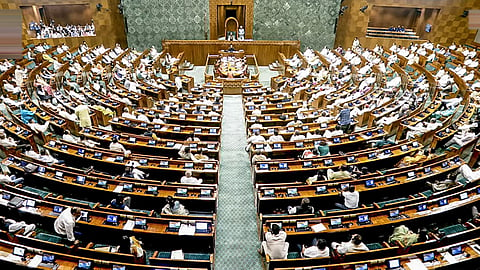

The Lok Sabha on Wednesday passed a bill to amend the anti-paper leak law, introducing stricter punishment of up to 10 years' imprisonment and a fine of Rs 50 lakh, amid sloganeering by Opposition parties.
The Public Examination (Prevention of Unfair Means) Amendment Bill, 2026, was introduced in the House by Union Minister Jitendra Singh on July 27, days after large-scale student protests led by the Cockroach Janta Party forced Dharmendra Pradhan to resign as education minister.
Speaking in the Lok Sabha, Singh said the government had acted swiftly in the NEET paper leak case and that 52 FIRs had been registered since the anti-paper leak law came into force in 2024.
He said the amendment Bill showed that the government was willing to learn from experience, adding that the number of suicides linked to paper leaks had also declined in recent years.
Singh also criticised Leader of Opposition Rahul Gandhi, saying he lacked knowledge of parliamentary norms and the functioning of the government.
Participating in the debate on the Bill, Gandhi accused Union Home Minister Amit Shah of authorising the firing on student protesters during the alleged police crackdown.
BJP members demanded an apology and evidence to support the allegations, while Speaker Om Birla later expunged Gandhi's remarks.
The Lok Sabha was adjourned for the day shortly after the Bill was passed.
Protests by opposition parties over the NEET issue led to daily disruption of proceedings in the first week of the Monsoon session of Parliament.
The 2024 law was brought in when the government faced raging paper leak controversies.
Before this legislation, there was no specific substantive law to deal with unfair means adopted or offences committed by various entities involved in the conduct of public examinations by the central government and its agencies.
The Act aimed to prevent unfair means in the public examinations conducted by the Union Public Service Commission (UPSC), the Staff Selection Commission (SSC), the railways, banking recruitment examinations and the National Testing Agency (NTA), among others.
Responding to Congress leader Gaurav Gogoi's remarks alleging that on innocent children atrocities and oppression were inflicted, Singh said, "utmost restraint was exercised and it was made sure that casualties do not happen".
According to the Public Examinations (Prevention of Unfair Means) Amendment Bill, 2026, investigations into paper leak cases are to be completed within two months.
The bill says that individuals involved in paper leaks or unfair means in exams will get jail terms for a minimum of 5 years and a maximum of 10 years, and a fine of up to Rs 50 lakh.
For organised crimes, the bill proposes a minimum sentence of seven years and a fine of up to Rs 10 crore.
The amendment bill seeks to empower all the state governments and UT administrations to designate any court of session to be a special fast-track court to try offences under the proposed law.
It also provides that the proceedings in such courts are continued on a day-to-day basis and the trial is completed within three months from the date of filing of the charge sheet.
It also empowers the central government to constitute a special task force for investigation of any offence, if necessary.
(With inputs from PTI)
