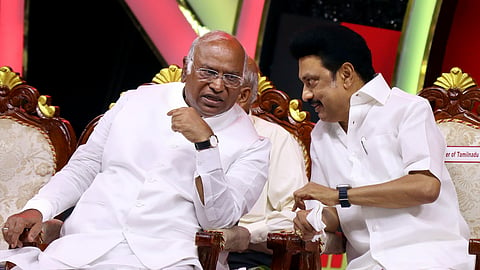

With differences emerging within the INDIA bloc over the Centre's proposed delimitation Bills, a delegation of top INDIA bloc leaders, including Congress president Mallikarjun Kharge, former party chiefs Sonia Gandhi, Rahul Gandhi, and TMC supremo Mamata Banerjee, is set to hold discussions with DMK chief MK Stalin in Chennai and NCP(SP) chief Sharad Pawar in Mumbai on Sunday, ahead of the special sitting of Parliament
The delegation would also include Karnataka Chief Minister DK Shivakumar, Telangana Chief Minister Revanth Reddy, Kerala CM V D Satheesan, and TMC national general secretary Abhishek Banerjee, while Shiv Sena (UBT) chief Uddhav Thackeray may join the meeting in Mumbai, they said.
The meetings assume significance as both the DMK and the Sharad Pawar-led NCP faction have indicated support for the proposed legislation, breaking ranks with several Opposition parties.
The Congress is understood to be seeking to address the differences and evolve a coordinated Opposition strategy ahead of the special sitting of Parliament beginning Monday.
The INDIA bloc floor leaders, meanwhile, met at Kharge's residence in New Delhi on Saturday to discuss a common response to the proposed legislation. Following the meeting, Kharge announced that the Opposition alliance would oppose the Bills, describing them as a threat to democracy. The bloc has demanded that the 33 per cent women's reservation be implemented within the existing strength of the Lok Sabha rather than linking it to an expansion of seats.
The DMK's decision to support the legislation came after a meeting of its MPs chaired by Stalin at Anna Arivalayam, the party headquarters in Chennai, on Saturday.
Senior DMK leader and former Union minister A Raja said the party's two principal demands concerning Tamil Nadu's parliamentary representation had been incorporated into the revised Bills.
Stalin described the decision as a victory for the party's sustained three-year campaign, saying the DMK had never opposed delimitation but had consistently opposed any exercise that would deprive states of their rightful representation.
The party's two demands were that Tamil Nadu's existing 7.18 per cent share of Lok Sabha seats should not be reduced and that the proportion of parliamentary representation among states, based on the 1971 Census, should be retained for another 25 years.
Under the revised proposal, Tamil Nadu's Lok Sabha seats are expected to increase from 39 to 51, while its share of the total seats would marginally rise from 7.18 per cent to 7.21 per cent. Stalin said the arrangement would protect the state's parliamentary representation for the next 25 years.
A Raja, meanwhile, said the DMK's position had remained consistent irrespective of whether it was in power or in the Opposition. He said the party was supporting the proposed 50 per cent increase in seats because its demand that Tamil Nadu's share should not be reduced had been addressed.
"Our consistent demand is that the share of 7.18 per cent in the Lok Sabha should not be altered. Now it is being maintained. Of course, procedural issues are there; we will address them," Raja said.
He, however, flagged reservations over the functioning of the proposed delimitation commission, particularly regarding the redrawing of constituency boundaries. The party could seek changes to the provisions governing the commission, if necessary, he said.
Rejecting suggestions that the DMK had changed its position because of its differences with the Congress, Raja said the party's stand had been consistent and that other Opposition parties, including the Congress, had earlier agreed with its demand for fair delimitation.
The Sharad Pawar-led NCP (SP) has also indicated support for the proposed legislation. Party leader and MLA Jitendra Awhad announced the decision on Friday after meeting Pawar, saying the party would support a uniform 50 per cent increase in Lok Sabha seats across all states.
NCP (SP) working president and MP Supriya Sule had earlier said the party would examine the provisions of the proposed legislation before taking a final position. The party's support is also linked to the implementation of women's reservation, an equal increase in seats across states and adequate representation for Opposition parties in the delimitation commission.
The NCP (SP), which has eight Lok Sabha MPs, was absent from Saturday's INDIA bloc strategy meeting, adding to concerns over the Opposition alliance's ability to maintain a united position on the legislation.
The Union Cabinet approved the proposals on Friday. The government is scheduled to introduce the Constitution (132nd Amendment) Bill, 2026, and the Delimitation (Second) Bill, 2026, in the Lok Sabha on Monday. Union Minister Arjun Ram Meghwal is expected to table the Bills.
The proposals seek to increase Lok Sabha and state Assembly seats by 50 per cent across states and Union Territories, with the revised distribution of parliamentary seats among states protected until 2051. They also seek to facilitate 33 per cent reservation for women in Parliament and state legislatures following delimitation and provide for the constitution of delimitation commissions.
The special sitting of Parliament will run from November 30 to December 3, with the Lok Sabha meeting on Monday and the Rajya Sabha reconvening on Wednesday, December 2.
The Constitution Amendment Bill will require a two-thirds majority in both Houses of Parliament and ratification by at least half of the state legislatures.
