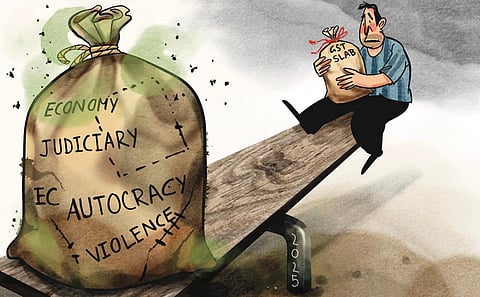

Time is relentless in its forward march. As we leave 2025 behind, we need to reflect on what we lost and what we gained. The year 2025 had many lows and a few highs.
Let us talk of the highs first. Pahalgam tested us, and Operation Sindoor that followed proved to be an effective response, though we are not aware of the full story.
The second high was the realisation that dawned on this government that the problems with the multi-slab GST, which negatively impacted the small-scale sector in particular, needed to be addressed. The realisation, though, came too late and the government at last simplified the GST by limiting it to two slabs of 5 and 18 percent, plus a special rate on sin goods.
I wish Arun Jaitley had listened to Arvind Subramanian, who, as the then Economic Advisor to the Government, vehemently opposed the multi-slab tariff.
The third high was that despite high tariffs imposed on us by a whimsical US President Donald Trump, we have somewhat managed to navigate our economy, perhaps because of domestic consumption, achieving over 6 per cent growth in GDP. The other high is that the inflation rate in recent months has been relatively low, as the government claims.
But here is the rub. The abrupt ceasefire declared during the ongoing Operation Sindoor, which Trump attributed to himself through multiple statements, and the multi-party delegation’s failure to elicit the response we expected from the global community, reflected poorly on our foreign policy and diplomatic manoeuvrability.
Even our own citizens were surprised by the ceasefire, given the media blitzkrieg on display.
As regards economic growth, several economists are of the view that the over 6 percent growth claimed by this government is highly exaggerated, actually hovering around 3-4 per cent, and that the data put out by the government is to be suspected.
Even the International Monetary Fund has indicated that the government’s data in this regard is not entirely reliable. For an international agency to comment on the veracity of official data carries significant consequences, making prospective investors wary. These are real lows and do not augur well for our country.
But the deepest low comes from the fact that the umpires under the Constitution have stopped performing their duties. The bedrock of our constitutional structures is the impartial and transparent manner in which they are required to perform their functions. The Election Commission of India acts as the umpire in the conduct of elections.
The sudden, ill-thought-out, and ill-timed decision to conduct a nationwide special intensive revision (SIR) of the electoral rolls is not based on any empirical data or analysis of why the electoral rolls are so flawed that the election results do not reflect the real will of the people.
It is believed that no collective decision was taken by the Commission as a whole to launch this enterprise. The manner in which the SIR is being implemented is highly unsatisfactory. The belief gaining ground is that the Commission is an institution that works at the government’s behest, and that the exercise of SIR is meant only to ensure a particular outcome. This has never happened before.
The other umpire that has failed to deliver is the judiciary.
Targeting opposition leaders through investigating agencies like the Enforcement Directorate and Central Bureau of Investigation makes one wonder about the moral fabric of these agencies, which are seen to be acting only at the behest of the government.
It is ironic that there is no ED action against those in the government, whether at Centre or in the states ruled by the BJP, or those in support of it, despite the prime minister himself levelling serious allegations against many of them at one point.
The ED seems to have the liberty, as soon as an FIR is lodged, to foray beyond the territories of any state to target political opponents and other public functionaries.
The courts hardly ever grant bail to such targeted opponents. Attempts have been made to topple governments through the actions of these agencies. The rule, ‘bail and not jail is the norm’, has been flouted even by the judiciary, particularly at the Special Courts level.
Journalists are persecuted, students are silenced, and citizens with an alternative point of view are picked out by foisting false cases against them. They do not get bail for years. The trial against those charged in the Delhi riots is a case in point.
But the unkindest cut of all is the autocratic political establishment, which does not believe in dialogue either within or outside Parliament. The consultative process in matters of governance, economy, foreign policy, and the introduction of important legislation, which has been the tradition, has been given the complete go-by.
There is also indefensible duplicity on display in as much as the prime minister, while on the one hand visits the church to share the joy of Christmas, the goons of the Vishva Hindu Parishad and Bajrang Dal, on the other, target Christians with impunity. The other sizeable minority is singled out and publicly vilified.
Violence against some of them is often not acted upon. Those prosecuted for crimes against the minority are often granted bail, but the prosecuted minorities are seldom released with the same alacrity. These are matters of grave concern apart from being an affront to our long-cherished concept of fraternity.
The constant attempts to control educational institutions by appointing pliant vice chancellors and heads of institutions who embrace a particular ideology do not augur well for India.
The nation needs to learn from its mistakes. It needs to realise that the time has come for it to stand together to meet the challenges that confront us, especially those posed by Donald Trump, who has changed the way nations deal with one another. As long as the high tariffs imposed by the US last, the Indian economy will continue to suffer and the rupee will continue to fall.
The challenges are enormous, and we need a calibrated approach to address them. We need a wise prime minister, a prime minister who realises that power is never forever.
Kapil Sibal | Senior lawyer and member of Rajya Sabha
(Views are personal)
(Tweets @KapilSibal)
